
Receive new posts as email.

| Sun | Mon | Tues | Wed | Thurs | Fri | Sat |
|---|---|---|---|---|---|---|
| 1 | 2 | 3 | 4 | 5 | 6 | |
| 7 | 8 | 9 | 10 | 11 | 12 | 13 |
| 14 | 15 | 16 | 17 | 18 | 19 | 20 |
| 21 | 22 | 23 | 24 | 25 | 26 | 27 |
| 28 | 29 | 30 |
This site operates as an independent editorial operation. Advertising, sponsorships, and other non-editorial materials represent the opinions and messages of their respective origins, and not of the site operator. Part of the FM Tech advertising network.
Entire site and all contents except otherwise noted © Copyright 2001-2010 by Glenn Fleishman. Some images ©2006 Jupiterimages Corporation. All rights reserved. Please contact us for reprint rights. Linking is, of course, free and encouraged.
Powered by
Movable Type
Steve Stroh has taken a close look at Craig McCaw's recent purchases in the broadband wireless space: McCaw bought Clearwire, a Texas company that controlled some ITFS spectrum--ideal spectrum for broadband wireless. But Stroh thinks that one of the most important aspects of what McCaw is doing includes the purchase of gear maker NextNet.
NextNet was around during the last big interest in MMDS in the mid-1990s and McCaw has been an investor in the company. NextNet is part of the WiMax Forum and says it intends to build WiMax equipment, but Stroh thinks that McCaw is likely to use NextNet's proprietary gear to get a jump on the market.
The first certified WiMax gear from almost every vendor will operate in licensed bands in international markets. One analyst recently told me that WiMax equipment designed to operate in the U.S. probably won't appear until late 2005 or possibly 2006. In the meantime, McCaw can use NextNet's gear and beat potential competitors to the market.
Also, with McCaw in control of NextNet, he can make sure that the vendor is making the gear he wants. As Stroh notes: "McCaw learned from Nextel that if your service depends on the whims of your supplier, they can dictate things that can materially affect the service."
McCaw could migrate to WiMax in the future in order to take advantage of potentially lower cost equipment. But Stroh notes that in many cases the proprietary gear may be better than the WiMax equipment. "WiMax is a compromise," he notes. Even if the customer equipment from Clearwire is more expensive than that of WiMax gear, McCaw will have a head start, Stroh says.
The new Clearwire Web site in part leads Stroh to think that McCaw is close to officially introducing the new business. McCaw may be trying to keep quite about his plans in an effort to try to buy additional ITFS or other spectrum at good prices, Stroh says.
Stroh says he dug up some other juicy information that's available to subscribers of his newsletter, Focus on Broadband Wireless Internet Access.
[Editor's note: When we point to a paid editorial resource, we like to be clear whether or not we have a financial relationship with that resource. We do not. We merely know that Stroh knows his stuff.]
Posted by Nancy Gohring at 2:42 PM | Permanent Link | Categories: Broadband Wireless
 Portless claims best reflashed Linksys WRT54G firmware for open network management to date: As part of ongoing work by several community groups, the Linksys WRT54G has become the base platform to try to tap into because Linksys relied so heavily on open-source software in its creation. It took a little cajoling to remind Linksys of these terms, but then they set up this GPL source download center on their site, which is prominently linked from their Support section.
Now, providing the code and giving people direct access to modify firmware are two entirely different objectives, and while Linksys was obliged to do the former, the latter has been the work of many months by several teams who have reverse engineered a number of key elements. The Portless release, say its engineers, relies on and improves the work of other groups and provides a full NoCatAuth portal. (Their software is under the GPL license.)
NoCatAuth is an open network authentication project that allows free networks to offer some controls over who uses it and how, such as bandwidth shaping and a click-through terms of service page that must be agreed to. Presently, you must have a separate computer running NoCatAuth, which adds to the complexity. The Linksys WRT54G, one of the best-selling Wi-Fi gateways of all time, is about $80 street price, making a community node a cheaper proposition.
The article linked to contains a comprehensive survey of similar projects, including news from Less Networks, which is in a technical pre-release at the moment of their modification of the NoCatAuth software for a less Unix savvy installation by average mortals who have the same desire to spread community networking but lack the technical chops.
Posted by Glenn Fleishman at 6:49 AM | Permanent Link | Categories: Community Networking, Hardware
London's Westminster Council will build an enormous wireless zone for closed-circuit television (CCTV) monitoring; public access, unavailable: The project might create the world's largest wireless zone, but this won't be useful initially to its citizens, only to the monitors of the peace who observe goings on by camera day and night. They also envision connecting people to "Council services," which might include monitoring the elderly. (The British have such a penchant for "monitoring." Thank goodness, as previously reported, they now have enshrined privacy rights...which allow CCTV everywhere.)
Over at Techworld, Peter Judge reports that the network won't be connected to the Internet nor can the council offer for-fee access by law. The idea of free access doesn't appear to have come up.
Posted by Glenn Fleishman at 6:37 AM | Permanent Link | Categories: Hot Spot, International, Municipal, Politics | 1 TrackBack
Taubman Centers, major mall operator, adds free Wi-Fi to Virginia mall; sign of things to come: The reporter did his homework, and this isn't a unique installation. We know from this article that there are 1,130 malls in the U.S. with only a tiny fraction having Wi-Fi. (Two are in the Seattle area, University Village and Bellevue Square, operated for fee by Cometa Networks.)
But 100 malls operated by either Westfield America Trust and Taubman may have free Wi-Fi added, with Westfield strongly committed.
Posted by Glenn Fleishman at 10:11 PM | Permanent Link | Categories: Hot Spot
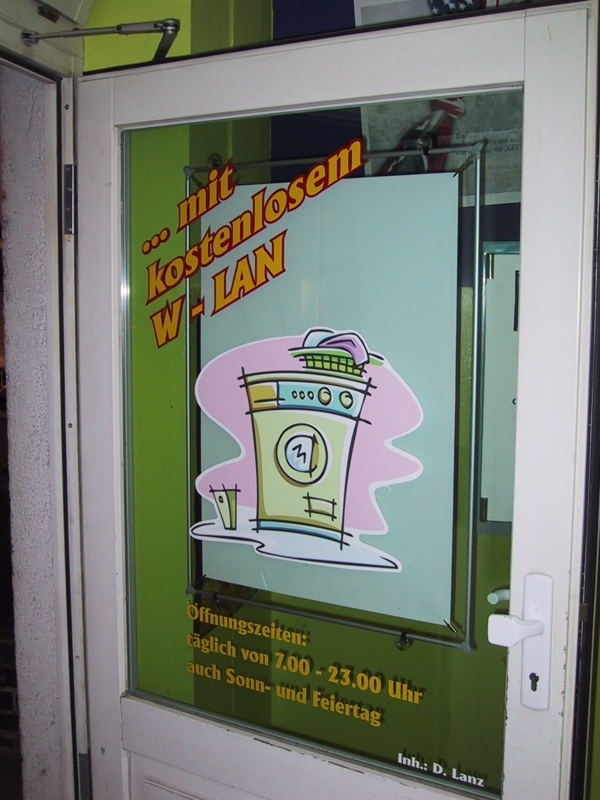 Mike Rutenberg offers this photograph of laundry-Fi: Kostenlosen W-LAN = free Wi-Fi in a Munich laundromat. You can sit, you can spin, you can surf.
Posted by Glenn Fleishman at 3:03 PM | Permanent Link | Categories: Hot Spot, International, Unique
While many communities around the country vaguely hope that wireless networks will bring business to town, this Indiana town has some very real reasons for wanting broadband: Scottsburg, Ind. couldn't get any kind of broadband access from the incumbents so it spent $350,000 to build a wireless broadband network. The network equipment comes from Alvarion, which means that it's probably proprietary gear based on 802.11.
The network has a very tangible economic affect on the town. Apparently, Chrysler promised to shut down the local Chrysler repair shop, which employs 60 people, if they couldn't get fast Internet access. Other local workers who telecommute threatened to move if they couldn’t get high-speed Internet access. Plus, the school system is saving a bundle with the new service.
This Indiana town most certainly isn't alone in wanting broadband but failing to get it from the incumbents. While we already see lots of wireless ISPs serving these small markets, clearly they aren't serving every community that wants broadband. Perhaps WiMax will drive down prices enough to encourage WISPs to build out in more small towns.
Posted by Nancy Gohring at 2:51 PM | Permanent Link | Categories: Community Networking
MuniWireless reports that a tribe in Southern California is using broadband wireless to link 18 tribal communities: HP donated a bunch of gear for the network and the tribe is using solar-powered antennas. In addition to the educational benefits to such a network, tribal members are using the access to keep on top of and apply for federal grants.
We've linked to other stories about tribes around the country using wireless to bring Internet access to reservations. In most of these cases, the incumbent operators weren't interested in serving the communities, which are often remote and sparsely populated. But the growth of Wi-Fi has driven down the cost of some equipment such that it's possible for these communities to build their own networks. Many of these tribes aren't looking to the Internet for entertainment but as a way to improve the educational and employment opportunities for residents.
Posted by Nancy Gohring at 2:22 PM | Permanent Link | Categories: Community Networking | 1 TrackBack
PC Magazine rounds up several 802.11g routers, and says they're cheap enough, they're good enough: 802.11b no longer enjoys a large enough (or any) price differential for quality Wi-Fi gateways that include WPA encryption support, PC Mag says. So while you can still find 802.11b devices on the market, they recommend new gear have 802.11g built in. The overall package of reviews and related stories in the issue starts here; use the table of contents at the right of that story to navigate through their guide to 802.11g, advice for buying, and reviews of individual routers.
The Linksys WRT54G gets top marks for 802.11g with a score of 4.5 out of 5 points; but six other gateways received 4 of 5 points, showing how the entire Wi-Fi world has matured into more usability.
Posted by Glenn Fleishman at 1:17 PM | Permanent Link | Categories: Hardware, Mainstream Media | 1 TrackBack
SkyRiver to install 22 Pinnacle hotels with all Wi-Fi service: Pinnacle has 22 properties in the western states and Ohio, and decided against hard-wired Internet because Wi-Fi made more sense as a plan for the future.
Posted by Glenn Fleishman at 1:01 PM | Permanent Link | Categories: Hotels
You might call it just a press release, but Indianapolis company wants to beat Hartford, Conn.: Wi-Fi network enabler Sputnik is working with an Indianapolis firm that appears slightly aggrieved that Hartford, Conn., has one-sixth the residents and more Wi-Fi hotspots. Their public (and public relations) goal? Boost Indianapolis from 48th in Intel's recent wireless cities survey up into the top 10. Austin's civic leaders and community networks have made similar statements about leveraging that city's wireless potential, and perhaps some civic boosterism can help grow Wi-Fi. In Austin, it's a mix of civic, commercial, and free community; this Indianapolis company appears focused on commercial with a little bit of free.
Posted by Glenn Fleishman at 12:54 PM | Permanent Link | Categories: Hot Spot
 Wi-Fi cradle allows Toshiba's 20 Gb music player to sync, broadcast: The Japanese-first Gigabeat can be backed up, loaded with music, or stream music over an optional Wi-Fi cradle. It's about $700 in Japan.
Posted by Glenn Fleishman at 12:50 PM | Permanent Link | Categories: Unique
4,000 access points in flyover: Mike Outmesguine brings a CNN representative (reporter?) and some other Wi-Fi fans on a warfly of Los Angeles. We flew from Brackett Field in La Verne (a.k.a. Pomona Airport) towards Pacific Palisades. Then we crossed over LAX into Rancho Palos Verdes and Long Beach. Then headed back to Backett. We picked up over 4000 access points while flying at varying altitudes.
Posted by Glenn Fleishman at 11:41 AM | Permanent Link | Categories: Unique
Sydney, Australia, WISP Unwired plans 50 by 60 kilometer coverage at 100 Mbps for 95 percent of Sydney: The company is signing up resellers and will install 63 towers at a cost of Aus$33 million by July. This all sounds somewhat unrealistic except that the firm has apparently already raised a fair amount of money and has its plans quite advanced. (Perhaps it's a fluke of the Australian market, but I don't understand how a firm raised money without a plan just by using a shell listed company to avoid the IPO process.)
The article muddles terminology enormously, which isn't unusual when new technologies appear. The journalist writes, Unwired's 802.16 standard-compliant Ultra Wideband (WiMax) network... Ultrawideband (UWB) is a short-range, high-speed technology. 802.16a is the standard underlying WiMax which has no final spec yet nor a certification program in place.
The last graf is somewhat mystifying: It has been reported that Intel is involved in the WiMax Forum certification group, an international 802.16 fixed broadband wireless access standard lobby group. Intel has not been hiding its interest, and WiMax may lobby but it's mostly about certification and education, from what we can tell so far.
Posted by Glenn Fleishman at 10:40 PM | Permanent Link | Categories: Broadband Wireless, International
Craig McCaw has reportedly bought a Texas company, Clearwire, that has ITFS spectrum assets: The ITFS band is near the MMDS spectrum but was set aside primarily for educational institutions. During the last period of interest in MMDS, during the mid-1990s, some companies, including Clearwire apparently, negotiated with the educational institutions to use or buy the spectrum. The spectrum wasn't widely used by the educational organizations that controlled the spectrum.
McCaw has long been interested in fixed wireless broadband. He founded XO Communications, which owns LMDS frequencies, in the mid-1990s. XO recently joined the WiMax Forum. ALso, Nextel owns a bunch of MMDS spectrum that it bought from Worldcom.
McCaw has assembled a who's who list of execs to run the new company, being called Flux. Many of them are McCaw Cellular veterans and have held posts in other McCaw companies. Notable are Nicholas Kauser who was the CTO for AT&T Wireless and currently sits on the board of numerous Seattle companies; Rob Mechaley, who was one of the founders of RadioFrame and before that Wildfire; and Gerard Salemme, who has been involved with several McCaw companies including satellite company ICO.
McCaw is notoriously mum about new ventures so it wouldn't be surprising if we don't learn details about this one for a while. But with real WiMax products becoming available in the near future, it would certainly be fair to suppose that the company may have ambitions of rolling out a fixed broadband offering using WiMax.
Posted by Nancy Gohring at 1:21 PM | Permanent Link | Categories: WiMAX
A few weeks ago, Microsoft posted the transcript of a chat about WPS, their Windows XP-only solution for standardized, wizarded Wi-Fi network provisioning: Although the fellow talks about the standards-based approach, it appears that the support on the client side will entirely be within Windows XP; it's unclear from this transcript whether non-Microsoft clients can be developed, but it might be the case. The idea behind this sort of wizard-based hotspot connection system makes a lot of sense, but a broader industry-based adoption would make it a better win for the hotspot operators who have to consider adopting it. T-Mobile is looking at both 802.1X and WPS, and may already quietly be in trials of both technologies.
Posted by Glenn Fleishman at 12:28 PM | Permanent Link | Categories: Hot Spot, Security
The folks who brought you the Pringles cantenna and the concept of an off-the-grid community wireless network have partnered in a new firm: Rob Flickenger and Matt Westervelt's Metrix Communications is attempting to be a one-stop shop for networkers trying to find commodity boards, antennas, kits, and parts that are surprisingly tedious to buy separately or as individuals. The gear is focused on outdoor, ruggedized equipment typically used for long haul or interconnection points, but they also carry less technical items, like a high milliwattage PC Card (200 mW).
Posted by Glenn Fleishman at 10:56 AM | Permanent Link | Categories: Community Networking, Hardware | 2 TrackBacks
 Champaign-Urbana Community Wireless Network releases first-generation mesh/cloud software, seeks input and development: I spoke with Sascha Meinrath, one of the folks leading the CUWiN project, about the scope of the project, their goals for outside participation, and his recent trip to Amsterdam to meet with a group designing documentation on wireless networks for developing nations.
The CUWiN project wants to allow self-forming, noncentralized, mesh-based Wi-Fi networks using standard, old PCs with no configuration. Slightly more advanced units could be ruggedized boxes using Compact Flash, but the basic unit would be a 486 or later PC with a bootable CD-ROM or bootable floppy that bootstraps a CD-ROM. Once booted, a unit finds other similar units without any other configuration or control and forms a mesh.
"We've been developing software now since about 2000, and our idea is to build software that is super user friendly, super easy for someone who doesn't understand the nuances of the technology or community wireless networking to set up their own system," said Meinrath. It's an attempt to enable community networking to spread beyond the folks who are self-starters.
To test their current software, they put together a bunch of old Pentium 133-based system with off-the-shelf Wi-Fi gear, burned CD-ROMs, booted the boxes and watched the mesh network form within five minutes.
However, the current generation of software "won't scale well: there's no route prioritization, and there's this problem of the hidden node problem," he said. (In a hub-and-spoke network, hidden nodes can see the hub not other spokes and can disrupt other network traffic by improperly sending at times when other nodes are transmitting resulting in interference and back-off behavior that reduces network performance. Mesh avoids some hub and spoke problems, but can effectively move the hidden node problem to any mesh point that has some connected nodes that can hear each other and some that cannot.)
CUWiN is design a system to prioritize routes among mesh nodes based on MIT Roofnet, and are looking into the Hazy Sighted Link State (HSLS) routing issue. HSLS uses packet economics: more dropped packets in a given route de-emphasizes it shunting more traffic to more successful routes. (Read more about this in CUWiN's FAQ.)
The software release by CUWiN of a CD-ROM image containing bootable node software along with the developer's resource (distributed under a BSD license with plans to move to a GPL license) is part of their effort to bring in more programming aid on the project. "We're relying on the open source community to provide us with feedback and ideas," Meinrath said. "A lot of our inspiration definitely comes from other wireless groups."
Meinrath noted that other groups are working on similar but not totally related problems. The HSLS issue is one that he believes no one has tackled directly and the group knows is central to providing the decentralized, non-hierarchical, dynamically prioritized system they want to offer.
Interested developers can download the CD-ROM image or contact CUWiN directly to get source code for the bootable project and the Compact Flash version.
On a somewhat related front, Meinrath recently returned from the first meeting in Amsterdam of The Tactical Technology Collective, which works with the Open Society Initiative and the Soros Foundation Network. The group's goal, Meinrath said, is to put together a resource guide for development nations that has all of the components for building a wireless network: regulation, configuration, installation, and other details.
Participants came from around the world, including Denmark, the U.S., Senegal, Indonesia, Canada, and London. The members aren't just from developed nations, but include people out in the field in community wireless in developing countries.
"The focus is on training manuals and on those sorts of resources rather than implementation, which is good and bad -- which is good and incomplete," Meinrath said. "One of the problems that we see a lot is that people develop really cool hardware that's far beyond the means of people on the ground where this equipment is supposed to be used." The group hopes to have the initial documentation complete in six months.
The Tactical Tech group's social goal is partly the motivation for the CUWiN project as well: to develop technology that relies on its intelligence rather than the cost of the components, making the use of several generations-old computer technology feasible.
CUWiN's current disk image is about 30 Mb, and they have a beta that requires just 13 Mb. Their ultimate goal is to reach 2 to 4 Mb in size so that it can be flashed (written into erasable programmable memory) onto commodity units with those limits.
The current generation of Compact Flash CUWiN software has solved a vexing problem: they can now flash upgrade units by connecting to them wirelessly without swapping out the Compact Flash card.
Meinrath said fundamentally, "We're most interested in how to build a system in which anyone, not just a techie, can set up a mesh with as few as two and as many as 1,000 nodes."
He offered some recommended reading on both the education site at the Free Press's Wi-Fi section (which includes excellent graphics about different community network configurations), and the CUWiN grant from the OSI.
Posted by Glenn Fleishman at 10:41 AM | Permanent Link | Categories: Community Networking, International, Mesh | 7 TrackBacks

Posted by Glenn Fleishman at 9:40 AM | Permanent Link | Categories: 2.5G and 3G, Self-Promotion, Voice
Qwest's DSL modems are available as retail items at Best Buy including a DSL plus Wi-Fi option: DSL carriers are obviously finding it better to compete with cable by offering essentially free sharing of a single connection as an official option. The retail packaging of a Qwest DSL modem is supposed to reduce Qwest's cost even further in a DSL installation. Most DSL is now self-installed, removing the expensive cost of a truck roll.
Posted by Glenn Fleishman at 9:21 AM | Permanent Link | Categories: Hardware, Home
The Open Park Project opened a free hotspot on the Washington, D.C., mall today: Service is available in the vicinity of the Capitol Visitors' Center, Supreme Court, and Library of Congress. Plans ultimately call for the zone to extend through most of the mall from the Washington Monument to Capitol Hill.
Posted by Glenn Fleishman at 9:19 AM | Permanent Link | Categories: Hot Spot, Politics
To tackle poor Wi-Fi certification first-pass rate, University of New Hampshire's InterOperability Lab (UNH-IOL) offers approved pre-certification: This might sound obscure, but it's a way for companies to save potentially hundreds of thousands of dollars and weeks of work off the budget for developing Wi-Fi products. The Wi-Fi Alliance has said that 25 percent of the products reaching their labs don't pass Wi-Fi certification tests the first go-round. The UNH-IOL will provide an intermediate testing program that will allow mid-stream course correction with ostensibly less cost. Lab users must pay fees unless they support the lab directly, and must be Wi-Fi Alliance members.
Posted by Glenn Fleishman at 9:16 AM | Permanent Link | Categories: Standards
RoamPoint entered the hotspot resale market in early April in a sea of confusion: Wi-Fi Networking News recently talked to Leon de Beer, director of RoamPoint, as well as iPass, a potential RoamPoint competitor, to straighten out some of the confusion.
RoamPoint was started by de Beer and some colleagues who identified the need for a process that makes it easier for hotspot operators to handle the necessary backend support behind roaming agreements, such as authenticating users across networks and tracking usage across roaming networks. The Cloud, a UK hotspot operator, was thinking along the same lines at the same time.
"What we've done is use some of The Cloud facilities to kick start this project and we’re now in the process of spinning it out of The Cloud," de Beer said. The Cloud is currently the majority shareholder in RoamPoint, but de Beer said both entities are hoping to change that soon. "For us, it's really important to be seen as an independent entity not closely associated with one network," de Beer said.
Intel is involved with RoamPoint in a co-marketing relationship. Plus, RoamPoint customers must be validated through the Intel Centrino verified hotspot network operators program.
RoamPoint hopes to serve as a hub and clearinghouse for hotspot operators and service providers. "We'll deal with the technology and you concentrate on the commercial," de Beer tells potential customers.
The RoamPoint hub offers several services to operators. When a customer accesses a hotspot using their home network's or aggregator's login information, their authentication request passes through the RoamPoint platform. RoamPoint doesn't handle the authentication, but it verifies if the user is authorized to access that hotspot through a roaming agreement the customer's operator has with the hotspot. If the customer is authorized to access the hotspot, RoamPoint passes the authentication request on to the customer’s operator, where the customer is authenticated.
Because RoamPoint will know which method each of its operator customers uses to authenticate users, RoamPoint can also serve as a central point of information for its customers. Before a hotspot operator approaches another operator about a potential roaming agreement, RoamPoint can identify for its customers which other operators in the network can support their authentication method.
RoamPoint also does network monitoring and collects data about all the hotspots of its customers. "We need to make sure that the service provider can tell customers which hotspots should be working. To collect all that data and make sure we hand it to the customer is non-trivial," said de Beer.
RoamPoint does not handle billing or settlement but it collects session records and hands the data on to the billing provider or clearinghouse used by each carrier. Carriers pay a fixed connection charge plus a fee for each authentication request that runs through the RoamPoint platform.
Last summer, iPass introduced a clearinghouse for roaming based on the platform it had already developed for internal use to handle authentication, security, and fee settlement tracking among its hotspot operators. "It's an adjunct business. It's something we were doing anyway in terms of clearing and transaction and settlement. So we created an offering around that and offered it to carriers," said John Sidline, director of corporate communications for iPass. Customers of the service can also self-brand the iPass client.
Most customers of the service are operators that don't have a Wi-Fi footprint who use the service as a go-to-market strategy, he said. Once the operator customer establishes a link to iPass, it can either negotiate roaming agreements individually with operators in the iPass network or buy access to other networks from iPass. For example, Sprint is using the roaming service from iPass. Sprint may be able to negotiate better roaming terms from one of the operators that is part of the iPass network than buying access to that network from iPass. Regardless of the deal the operators make with each other, iPass will facilitate the backend settlement accounting and authentication for Sprint.
The one requirement is that operator customers allow iPass end users to roam onto their hotspots. iPass will facilitate roaming between an operator customer and an operator that may not be part of the iPass network.
While the offerings from iPass and RoamPoint sound similar, neither company seems particularly concerned about the other. "It's a very small piece of our business," said iPass's Sidline. "There's going to be lots of players coming in doing a variety of different things that are already being done but it's a large world and there's plenty of opportunity."
RoamPoint wasn't aware that iPass had a similar offering. "We're not aware that they've actually offered any kind of clearinghouse," said de Beer. He suggested that iPass could become a RoamPoint customer. But Sidline said there'd be no need for that because iPass has already invested several years into streamlining its roaming processes.
Posted by Nancy Gohring at 9:13 AM | Permanent Link | Categories: Roaming
RFID Journal provides the  detail on Legoland's kid-tracking Wi-Fi hardware: The magazine provides piles of additional detail about the Denmark theme park's system to let parents find their children if lost. The system combines BlueSoft's AeroScout system with software by KidSpotter, which on its Web site, is more explicit that the system can be used to track visitors patterns for better park optimization.
About 1,600 children or 0.1 percent of the 1.6 million visitors, become separated from parents each year, so it's a small but significant problem. The rental fee is €3 per day; the entrance fee is mid-€20s. The park is installing 38 AeroScout units which cost from $3,000 to $4,000 each. The tags themselves cost about $85 each and the park is starting with 500 of them.
Not mentioned in this article is that the tags use very tiny amounts of one-way signalling which allows their batteries to last for years.
Posted by Glenn Fleishman at 6:16 PM | Permanent Link | Categories: Future, International, Unique
 I know it's PR, but it's good PR: science museum gets free network because Ethernet won't work: Strix has a brilliant little contest running to promote the use of its wireless backhaul and access point system in buildings that are impossible to affordably pull wire through. I've heard that museums are a great category in general, because they're either built so thickly to ensure temperature control or they're converted from another purpose now defunct (textile mill, hardened office building, etc.).
In February, a prison in San Antonio won the contest. The latest winner is The Science Place in Dallas.
Posted by Glenn Fleishman at 1:25 PM | Permanent Link | Categories: Enterprise, Unique
Dow Jones Newswires reports that 100 McDonald's restaurants in Portugal are equipped with WiFi: Access will run €2.00 for 30 minutes with the purchase of a McMenu or McMenu Grande meal. Service will be available in all 113 restaurants in Portugal in the future.
Posted by Glenn Fleishman at 1:14 PM | Permanent Link | Categories: Hot Spot, International
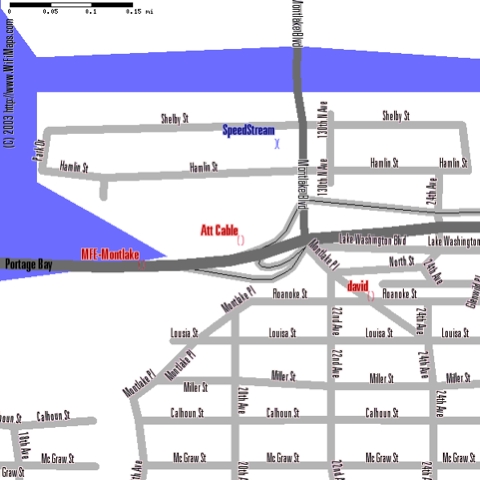 I can't see my house from here: WiFiMaps has interactive map of wardriving database: Although nodedb has been around for quite a while, offering geographic information system (GIS) mapping of access points to graphical maps, WiFiMaps has a crisper display and shows the results of wardriving and other sources. It's a good way to tell whether anyone knows your network exists (mine hasn't been stumbled in this database), and to find out how active Wi-Fi is in your neighborhood or community.
A colleague wrote in after I posted this to remind me of the fine folks at wigle.net who have 900,000 access points in their wardriving database along with downloadable Java and Windows client software which lets you load browsable map modules; you can also browse certain cities through a Web interface. While the maps aren't as pretty, they're quite good, and the URLs correspond to specific locations where WiFiMaps hides the URL-to-location mapping. They don't show my home network either (thankfully?).
Posted by Glenn Fleishman at 1:06 PM | Permanent Link | Categories: Community Networking
Posted by Glenn Fleishman at 10:11 PM | Permanent Link | Categories: Municipal, Rural
WiFile is a Palm application that allows Samba (SMB) file sharing access over a Wi-Fi-enabled Palm OS 4 or 5 handheld: This solves a long-standing problem with the handheld devices integration with existing network storage infrastructure.
Posted by Glenn Fleishman at 12:59 PM | Permanent Link | Categories: PDAs, Software
McDonald's might bundle free access with a special meal, as they did during Wi-Fi trials, or offer premium content available exclusively or first in stores: Leonard Witt, a professor of communications at Kennesaw State University in Georgia, says that at the Go Mobile or Go Home conference last week, a McDonald's director listed off some of the tie-ins with Wi-Fi that the company will try, including exclusive music downloads and potentially games. The company has also already learned they need to add more electrical outlets. (Although with few outlets, you enforce a de facto two-hour limit on non-Centrino, single-battery customers.)
Posted by Glenn Fleishman at 12:57 PM | Permanent Link | Categories: Hot Spot
Atheros says their single-chip 802.11g product is shipping volume now to manufacturers: The CMOS-based chip design reduces overall cost and power requirements. The chip will be used by D-Link in new products. Included with the chip is the entire portfolio of Atheros features, including extended range and its controversial Super G mode.
Posted by Glenn Fleishman at 12:38 PM | Permanent Link | Categories: Chips | 1 TrackBack
Vivato's equipment will be used by ICOA to provide Wi-Fi service at the Spokane airport: The airport handles about 1.2 million passengers (counted once for enplanement/deplanement) per year. ICOA seems to be specializing in smaller but high-volume airports like Sacramento, Savannah/Hilton Head, and Fresno that require very little hardware but reach a million or more passengers a year. Extrapolating from Concourse's figures for usage at Minneapolis-St. Paul, these smaller airports should see 20 to 30 sessions per day.
Posted by Glenn Fleishman at 12:25 PM | Permanent Link | Categories: Air Travel, Hot Spot
BT, France Telecom, Qwest, Reliance, and XO have joined the WiMax Forum: Previously, AT&T and Covad were the only major operators in the forum. Having these heavy-hitters join is certainly a significant show of support, although none has yet pledged to use the technology.
It will be interesting to see how these operators might use WiMax. Operators could use WiMax for backhaul on existing networks. European cellular operators already use wireless more frequently than wired options to backhaul their networks, much more so than U.S. cellular operators, said Monica Paolini, the founder of Senza Fili Consulting. However, the press release about these operators joining the forum focuses on using WiMax to offer broadband Internet to end users. That emphasis could be just wishful thinking on the part of the forum or some of the operators may have expressed sincere interest in using WiMax to serve end users.
Posted by Nancy Gohring at 11:43 AM | Permanent Link | Categories: WiMAX
The Billund, Denmark, Legoland uses KidSpotter to track children in the park, if parents want: For a rental fee, parents can Wi-Fi enable their children preventing their unintentional loss across the 10-hectare (25 acre) theme park. If your child disappears, the parent uses SMS with their child's number, and they're providing with exact location information in response. It's the largest location-based Wi-Fi network in the world, the release says, meaning it's the largest network of its kind in which you can track items within it.
Bluesoft's technology is behind Kidspotter. They separately announced today that their Wi-Fi/radio frequency ID (RFID) tracking technology AeroScout WLAN Location is available for tracking all kinds of valuable assets (not just children) with precise location information across Wi-Fi networks. Because of the high per-unit cost, the company lists applications like tracking people, cars, and containers.
Posted by Glenn Fleishman at 11:41 AM | Permanent Link | Categories: Unique
Despite a trial and now commercial service of a broadband wireless offering in North Carolina, Nextel is reportedly still examining other technologies: Mobile Pipeline reports unnamed sources who say that Nextel is evaluating gear from IPWireless, though not in any public trials. While it's interesting to note a vendor by name, it's not big news that Nextel is looking at other equipment in addition to Flarion. The company has been fairly open about its interest in a variety of different technologies, ranging from CDMA-based networks to proprietary gear from Flarion. I've talked to a few analysts who say that Nextel is very seriously considering WiMax.
Posted by Nancy Gohring at 10:22 AM | Permanent Link | Categories: WiMAX
 It's not bait and switch, but between last night and this morning, Amazon.com raised the price on a NetGear and D-Link router: When we posted the deal last night, the NetGear WGS614 802.11g router was just $37 after rebate; it's now $57. The D-Link 802.11b DI-514 was $17.50 and it's now $20. Either the items were incorrectly priced originally, or Amazon.com has a feature that raises prices when interest expands--perhaps there's even another explanation.
Posted by Glenn Fleishman at 11:32 PM | Permanent Link | Categories: Deals, Hardware
 Investor's Business Daily notes that Wendy's may be challenging Burger King for the No. 2 fast food slot, but the CEO isn't interested in Wi-Fi: This perhaps puts Wendy's out of the near-term running for the next major QSR (quick-service restaurant) that adds Wi-Fi. But the CEO is dismissive:
At lunchtime, the idea is table turns and you don't want people staying at their tables surfing. If there's a way to do that in the afternoons only, we will, he says. However, he's not looking at his own numbers well enough. The article notes that 65 percent of Wendy's business is drive-through, and a significant fraction of its counter business is most likely take-away as well.
The idea of Wi-Fi is that it's a tool to load the restaurants during off-times. Businesspeople aren't going to come in and spend two hours over lunch trying to get work done, but they might spend money on food and Wi-Fi. A lack of seating rarely discourage the fast-food patron; they take it to go, if they have to, but they don't find another restaurant.
Posted by Glenn Fleishman at 5:13 PM | Permanent Link | Categories: Hot Spot
Posted by Glenn Fleishman at 5:02 PM | Permanent Link | Categories: Unique
The Alliance for Downtown New York proposes a wireless backup plan for telecommunications: For $10 million, the Alliance proposes building a laser and microwave system that would sit on top of five of the tallest buildings in the area and have line of sight from most offices. The system would relay to two other locations, one in Manhattan and one probably in New Jersey, in the event of a loss of service.
The idea is that companies unable to bear the enormous costs of building their own similar backup systems could piggyback on the Alliance's, which would be vendor neutral to phone companies. This might make businesses who locate in the area less concerned about being cut off from telecom in the future, come what may, although real estate agents think it won't make a practical difference: rents are cheaper and that attracts tenants.
The article mentions that the Alliance issued a report about its free Wi-Fi zones in which they said that the network had become one of the busiest of its kind in the world. However, the report isn't on their Web site; I'm trying to get a copy. The redundant telecom network could be used actively to provide more bandwidth to the free Wi-Fi zones, the Alliance said. [link via Craig Plunkett]
Posted by Glenn Fleishman at 7:48 PM | Permanent Link | Categories: Municipal
The Washington Post presents a summary of advice on finding hotspots, signing up for service: Daniel Greenberg points out the dilemma of Wi-Fi hotspots: if you don't know where they are, how do you find them? He mentions our partner Jiwire along with its free downloadable hotspot finding application (Mac, Windows, Linux), and Jim Sullivan's excellent Wi-Fi Free Spot directory. Greenberg also runs through options for paying (or not paying) for service at hotels, coffeeshops, and other venues.
The Post also ran a host of other Wi-Fi related articles. Elsewhere in the issue, Greenberg reviews four Wi-Fi home gateways in the same edition. He praises D-Link's configuration simplicity and Linksys's WPA support, but notes that when NetGear adds promised WPA encryption their unit would give the other two a strong challenge.
Mike Musgrove points out the problems of interference, drawing on sources like Matthew Gast to discuss how Wi-Fi networks in close proximity in adjacent homes and apartments could be a growing source of frustration to wireless users. Rob Pegoraro walks through Wi-Fi basics.
The package of stories also includes a couple of point of view pieces from people using Wi-Fi in typical ways: sharing with a neighbor , avoiding their own DSL bill by using free Wi-Fi, and the perils of Xbox Wi-Fi.
Christopher Confessore explains that for the cost of a couple of cups of coffee, he uses the free Wi-Fi at a local coffee shop. But this kind of free is interesting because he (like other patrons) feel compelled to buy service. He might be spending from $20 to $60 per additional to use the free service; for that price, he could camp out at a Borders or another venue in which because he's paying for access he doesn't feel the need to provide incremental revenue to the host.
Posted by Glenn Fleishman at 10:39 AM | Permanent Link | Categories: Hot Spot | 1 TrackBack
The Feature notes that cell data prices have dropped, quietly: A few weeks ago, it was $80 per month for unlimited data from those who offered unlimited plans, with lower fees only for metered services. Cingular offered no unlimited service.
In the face of faster national networks and Verizon Wireless's commitment coupled with T-Mobile ($20/month) and Sprint PCS ($15/month) pricing, The Feature's Eric Lin notes a host of small changes. Verizon Wireless is now down to $50/month for 1xRTT, but still charges $80/month for PC Card-based 1xEvDO. Cingular plummeted its GRPS and limited EDGE to $20 per month (but it's not listed as such on their site yet). AT&T Wireless is offering GPRS/EDGE at $45/month.
To quote Mike Masnick of TechDirt, So, now it seems that the entry point for the highest speed is $80, then you drop to $50 when there's a bit of competition, and down to about $20 when your service doesn't have much to distinguish itself any more.
Posted by Glenn Fleishman at 7:06 PM | Permanent Link | Categories: 2.5G and 3G | 2 TrackBacks
 The Wi-Fi Alliance, the group that certifies Wi-Fi equipment, moves its headquarters from Silicon Valley to Austin, Texas: The Wi-Fi Alliance is more a virtual organization with few staffers. The test labs it work with are under contract all over the place. A television station in Austin picks up the story and thinks that even though it will create no jobs in the Austin area, that there's a large impact involved. Sorry, folks, there won't be.
That's not to put down Austin (don't mess with Texas, as you know). Austin has a variety of free, community, and for-fee groups and companies including Wayport and Austin Wireless City. (Inset picture of Wayport's headquarters.)
Posted by Glenn Fleishman at 6:04 PM | Permanent Link | Categories: Standards
 Looking to become a hotspot? Jiwire has published an in-depth guide: There's no question we get more frequently at Wi-Fi Networking News than from individual venues or small chains of locations that want to install Wi-Fi service but don't know quite how to start or how to evaluate offerings. This Jiwire piece offers very specific advice and direction on making primary decisions--free or fee? on your own or in a network? turnkey or solutions provider?--and then who to turn to.
Posted by Glenn Fleishman at 5:05 PM | Permanent Link | Categories: Hot Spot
Spokane's proposal for a city-side network would have two parallel uses: a protected, private public safety net, and a public side for general use: The network currently exists downtown and response to the Washington town's effort has been positive. The downtown network will ultimately span about 100 city blocks and cost north of $500,000 due to donations from Vivato and other vendors. The city's pitch for funding will play on the improved service for public safety (fire, medical, police). Oddly, the story doesn't mention two frequently cited reasons for switching to Wi-Fi for public safety: redundancy with other coverage for emergencies, and cost savings because most public safety radio equipment uses licensed spectrum and proprietary devices.
Posted by Glenn Fleishman at 10:41 AM | Permanent Link | Categories: Municipal
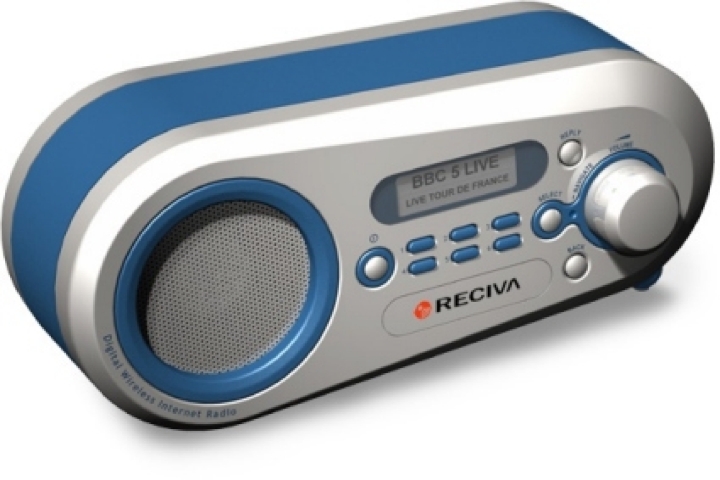 Two Wi-Fi radio radios are coming, reports The Register: Tony Smith discusses upcoming radios that will act like AM/FM tuners but work over Wi-Fi and the Internet. Both Reciva (startup) and Linksys (part of Cisco) will offer devices that handle radio stations streaming in many formats over the Internet. Linksys's product, which they apparently plan to make on behalf of other companies, will also support Real Networks' subscription-fee-based Rhapsody network.
Posted by Glenn Fleishman at 10:34 AM | Permanent Link | Categories: Unique
Somewhere between satire and anarchy lies parody: WiFi Hog kicks other users off public hotspots, even owner: This is clearly practical performance art, but it's an interesting Gedanken (und Praktisches) experiment as well. If a third party can gain access over a public hotspots, how does that transform the relationship of the owner and other users to that service? [link via comment on The Feature where David Pescovitz further explains the project.]
Posted by Glenn Fleishman at 4:03 PM | Permanent Link | Categories: Unique
Joi Ito's roaming comes home: $3,500 bill for mostly data (3rd item): Ito is a former venture capitalist and deeply involved with two companies I hold dear: Technorati (which tells me when folks link to this site) and Movable Type (which powers this site). But even such a globe-spanning sophisticate such as he can get it socked to him.
The Wall Street Journal reports that Ito's $3,500 cell bill, $2,800 of which was for cell data roaming charges representing 188 Mb of transfers, will appear in the next issue of Wired magazine.
Posted by Glenn Fleishman at 3:01 PM | Permanent Link | Categories: 2.5G and 3G | 1 TrackBack
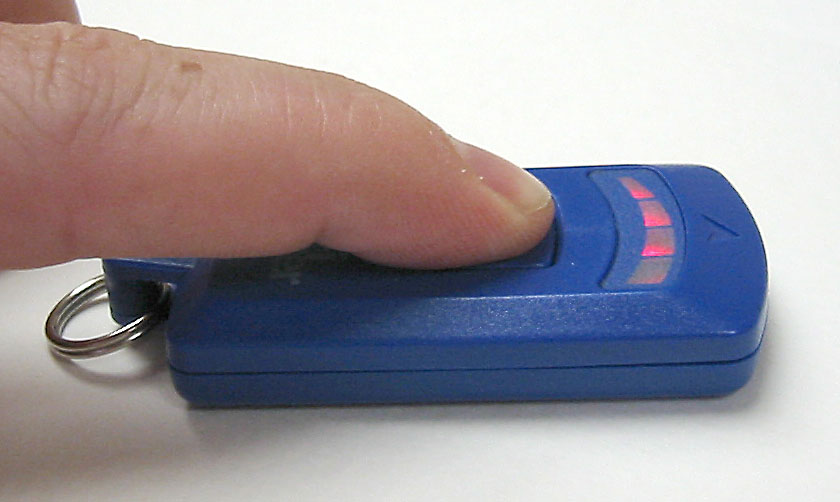
The Kensington WiFi Finder is relatively large (credit card sized) and scans before displaying the results instead of a constant active scan--but it can tell Wi-Fi from junk. WFS-1 from Smart ID is much cooler offering a no-industrial-design-intended box with instant scanning--but which "hears" all 2.4 GHz signals the same.
Push the button on the WiFi Seeker and it scans briefly, often under a second, before displaying a signal strength in zero to four LEDs (movie above requires QuickTime). Keep the button held down and it's a Wi-Fi dowser, allowing you to move around and see immediate response to different signal strengths. It's more directionally sensitive than the WFS-1.
Chrysalis will sell the device starting in June for $29.95, but you can sign up now to be notified when it's shipping. Earlier, PC Tel has said they would make the device available to their customers, and Chrysalis will sell custom branded versions of the device.
A reader who is a fan of the Smart ID WFS-1 wrote in to complain about my characterization of the WiFi Seeker as best in class. He's used the WFS-1 in hundreds of locations around the country, and considers its monitoring of the 2.4 GHz band (instead of just Wi-Fi signals) to be a plus, as he's learned to differentiate the pattern of flashing lights to distinguish from among Wi-Fi, microwave ovens, cordless phones, and other devices.
The WiFi Seeker displays solid lights to indicate Wi-Fi signal strength; the WFS-1 flashes or holds steady. I can see why this would be an advantage in mixed signal environments. For the purposes of my evaluation, I'm interested in determining only whether a Wi-Fi network is available. Case in point: at a hotel a week ago, I used the WFS-1 to see if there was an active Wi-Fi network. It flashed like crazy. After firing up a stumbling program and spending some fruitless time seeking the network, I realized the WFS-1 was showing my Bluetooth-to-computer connection. Perhaps with practice, I could have differentiated that.
I expect that a future generation of Wi-Fi detector will have the features that other readers have written in about: the ability to identify closed and open networks, and a display to show what network SSIDs (the Wi-Fi network name) were found, not just that a signal is present.
Posted by Glenn Fleishman at 2:36 PM | Permanent Link | Categories: Gadgets | 20 TrackBacks
Chinese reports indicate that proprietary Wi-Fi standard might not be dead yet: Reports in the country itself were sketchier or downright contradictory about the news yesterday that China had dropped its June 1 deadline and the requirement for using the proprietary WAPI encryption standard.
Posted by Glenn Fleishman at 1:06 PM | Permanent Link | Categories: Security
Personal Telco places latest free Wi-Fi node in World Cup Coffee inside Powell's City of Books store in Portland, Oregon: Powell's City of Books is, in fact, an entire city block, and the largest single bookstore in the world. They have outrigger stores nearby, including a vast technical bookstore. World Cup Coffee has been a big supporter of Personal Telco's efforts, as well.
Nigel Ballard of Personal Telco notes that This node goes live with experimental support for SIP-based VoIP (Voice Over IP) wireless phones such the Pulver WisIP and the Zyxel Prestige 2000W.
Powell's pioneered the unique art of shelving new and used books side by side, and first sold books over the Internet using telnet in 1994, predating Amazon.com.
Posted by Glenn Fleishman at 8:22 AM | Permanent Link | Categories: Hot Spot
Long-distance telephone company IDT will blanket an area of New Jersey with Wi-Fi and test low cost voice over IP: The service could cost just $2 per month and 5 cents per minute prepaid, and might be a tool to bring phone service to the cell-less -- or even the wireline-phone-less.
IDT is using a VoIP delivery service from Net2Phone, which was also announced today. Net2Phone will route calls for its wireless operator customers to its SIP-base platform, which does call management, billing, provisioning, and handles interconnecting with the PSTN. Net2Phone expects a variety of customers might be interested in the offering, including wireless ISPs, hotspot operators, cell phone or PDA makers, or anyone with a broadband connection. If the service is priced right, this could make it easier for service providers to offer voice over WLANs and could encourage more services to roll out.
Posted by Glenn Fleishman at 2:08 AM | Permanent Link | Categories: Voice
In light of McDonald's decision to team with Wayport, how many other chains are left? In an interview earlier today with Jeff Damir, a VP at Cometa Networks, he noted that there were many, many other quick-service restaurants (QSR) out there to talk to who might have an audience more interested in Wi-Fi hotspots.
Sure enough, QSR Magazine has a list of the top 50 QSR chains by dollar volume as of 2002. Only two of these chains, Starbucks and McDonald's, have a comprehensive Wi-Fi plan. Panera and Schlotzsky's have Wi-Fi in some locations with plans for expansion.
The total number of chain stores in the top 50 are 117,468, a staggering number, of which about 15 percent are committed to have Wi-Fi within a couple of years.
Posted by Glenn Fleishman at 9:33 PM | Permanent Link | Categories: Hot Spot
China shelves its proprietary Wi-Fi security plan: It's good news for all chipmakers that China has apparently rescinded its June 1 deadline for all Wi-Fi equipment to include a Chinese proprietary security standard only available for inclusion by Chinese companies. This would have exposed international intellectual property to companies most interested in competing with those firms, and would have caused a fragmented world market.
Richard Shim broke this story at News.com earlier today, and has an updated version will full details now. The deal came about in Washington, DC, as a result of joint trade talks with China.
Neither story mentions that Chinese actions in regard to WAPI and related issues put it in conflict with its membership in the World Trade Organization, a group they had lobbied to join for some years and to which they were accepted with the backing of the U.S.
Posted by Glenn Fleishman at 5:43 PM | Permanent Link | Categories: Security
Cometa Networks is one of the most talked-about hotspot builders, and the least well understood. Their CEO and their VP of sales and business development talked about the present and future dispelling some of the mystery: In an interview today with Cometa Networks' CEO Gary Weis and vice president Jeff Damir, the two executives provided context for their recent decisions, apparent setbacks, and their future planning.
Cometa Networks is a hotspot infrastructure builder, signing contracts with venues to build Wi-Fi network locations that they also provide technical and customer service for, and then resell access to those locations to service providers such as aggregators (like iPass, with which they have a relationship) and cell carriers (such as AT&T Wireless).
I've been one of the strongest critics of Cometa's ongoing development in part because of the initial hype (not all theirs) and the ongoing obscurity with which they have proceded. I came away from this interview quite convinced that Cometa's plans are much more in line with how the rest of the industry has matured and the needs of both venue owners with whom they must negotiate and service providers to which they have to sell their offering.
If anything, Cometa and Wayport have swapped places: Wayport is aggressively building as many as 17,000 hotspots in the next three years under contract, while Cometa's Weis and Damir said they are looking for the right partners to more cautiously build out a network in which every hotspot has the value that their upstream service provider partners want.
Weis joined the firm in March 2003, several months after its public launch. Weis stated at the outset when asked about the previous projections of Cometa's network growth, "I have taken a lot of time to work with the team we built to get it right, if you will, instead of shooting from the hip and talking off the cuff."
Even though Cometa started serving McDonald's locations around the time Weis joined the company--as part of the publicity associated with Intel's Centrino rollout--the main thrust of their current approach to which venues to partner with began in June 2003 when the firm decided to start a few months later in Seattle.
Weis said that Seattle was selected to "get us more information about what venues are really valuable, not just to our perception but to our service providers' perception." In September, they had 100 locations unwired, including McDonald's locations, which led ultimately to a couple hundred locations. After McDonald's signed with Wayport, Cometa is back down to about 100 Seattle venues.
The goal in Seattle was diversity: instead of focusing on single chains, Weis said, they installed hotspots into malls, office buildings, public spaces, fast-food restaurants, coffeeshops, bookstores, and car dealership waiting areas. "We're in a very diverse set of venues, not because we're confident that any one of those is right, but because we want to learn something in our first market rollout," he said.
As a result of the Seattle trial, Cometa was able to conclude successfully a year-long effort to sign Barnes & Noble in which they competed with Toshiba for the right to install Wi-Fi hotspots in 650 stores this year. Instead of building out city by city, which was a plan reported earlier when Cometa started in Seattle, Weis said the plan now is a "thinner, national footprint led by the anchor tenant Barnes and Noble." He noted, "We will also replicate what we did in Seattle" with other diverse venues.
Although Cometa was painted as the loser in the McDonald's trial in which Wayport came out above Cometa and Toshiba--which is handing its hotspot business over to Cometa--Weis said that their McDonald's hotspots turned out to have a pattern of usage substantially different, and ostensibly worse, than the other kinds of locations they tested.
"As we went into the final negotiations with McDonald's, we and Wayport, myself and the team had a very focused attitude towards putting a business proposition on the table that would be successful for the both of us," Weis said. McDonald's chose Wayport, but Jeff Damir noted that there are other restaurant chains that might be a better fit for Cometa's audience and the service providers they resell to.
"You look at the QSR segement, and what you find is that there a lot of players out there with thousands of locations, and not all of them have the same brand and ubiquity," Damir said. McDonald's is focused on drive-through and family service, emphasized by the play areas and children's Happy Meals, he noted. "You go to some other QSR [quick-service retail] players, and they're much more targeted: they don't have Happy Meals, they might have different approaches to the market, both in their environment and food--and in their marketing strategies."
Damir said that in the fast-food market, "there are still good powerful national brands that we would anticipate seriously considering and putting a partnership in place in the months to come." Both executives said they anticipated announcements about new providers and venues within weeks.
As a Seattlite myself, I asked fellow Emerald City resident Damir about a mall that turns out to be equidistant between his home and mine, University Village. In the mid-90s, the outdoor mall transformed from a set of run-down and off-brand stores to a vibrant, rebuilt complex that combines established local businesses with human-scale "big box" retailers like Barnes & Noble, Apple Store, Crate & Barrel, and The Gap.
Cometa unwired all of "U Village," as it's known, but the mall is home to at least four other networks, including T-Mobile in two Starbucks (including what is apparently the busiest Starbucks in the world), free service at the Apple Store, free service at a supermarket cafe, and nearby T-Mobile, Wayport, and Cometa service at Tully's, McDonald's, and Kinko's.
Damir lives close by, but, he said, "I haven't built all those locations just so it would be convenient for my life." It may be the most unwired place on the planet in terms of coverage and network multiplicity. "It's a very interesting micro-experiment of what you could expect to see on a broader basis around the country in the unlicensed spectrum environment that we live in," Damir said.
Weis cleared up a long-standing confusion over the investment structure in Cometa. Although he declined to provide dollar specifics, he stated that IBM and AT&T, almost always cited in articles as major investors in Cometa, were actually suppliers, not part of the core investment team, which is Intel Capital, Apex Partners, and 3i.
He also noted that their relationship reselling to AT&T's consumer business had come to an end, but that AT&T had tested this relationship only in Seattle. While AT&T declined to continue the service provider agreement, they did allow Cometa to send out a note to existing subscribers offering free access and future information about service plans. Weis said that 23 percent of the list responded, and that a future return of AT&T nationally wasn't out of the question.
Damir spoke to the Toshiba SurfHere location acquisition, and said that locations were being mutually evaluated by the venue owner and Cometa. "No one is going to be forced to work with Cometa and Cometa won't be in a position where they'll be forced to take on relationships," Damir said.
On price, Cometa hopes to be extremely competitive, matching the kind of threshold that Wayport has set with its $2.95 for two hours price for McDonald's outlets. Cometa has always offered competitive wholesale rates, with some of its service partners offering day passes for $3 to $5 and monthly unlimited access for $12.
"When you get above $5, there's a much smaller group of people who are willing to spend over $5 for that daily experience. When you come down towards three, you don't need to in our experience to come down much further than that," Damir said. Cometa has encouraged rates such as month-to-month unlimited usage at $11.95. Ultimately, service providers will set these prices.
Both Damir and Weis acknowledged that the company has been so heads down working on their deals the last several months that news has been scarce. Cometa is talking smaller, building bigger, and the next announcements should provide even more clarity about their path to profitability.
Posted by Glenn Fleishman at 4:11 PM | Permanent Link | Categories: Hot Spot | 1 TrackBack
Long-awaiting update to NetStumbler appears: The program's developer notes using extreme understatement: Since I released NetStumbler 0.3.30, I have experienced birth, death, illness, new job, and increased bandwidth costs. None of these will be helped by the arrival of both NetStumbler and MiniStumbler versions 0.4. Download and enjoy. Sorry it took so long.
The NetStumbler (Windows) and MiniStumbler (Pocket PC) applications let you scan for access points and record information about them, such as their unique interface address and whether security is enabled. You can pair scans with a GPS to build location-based awareness. [link via Gizmodo]
Simultaneously, iStumbler 84 was released for Mac OS X 10.3.
Posted by Glenn Fleishman at 12:22 PM | Permanent Link | Categories: Hacking
T-Mobile UK has service in dedicated bays in 100 Texaco stations near major UK roads: The deal could ultimately result is as many as 1,400 company-owned Texaco stations having T-Mobile UK service, but a limiting factor is dedicated parking space for motorists using the service. There's an undertone in The Register article and press releases about not just backing up the pump lines (a problem for a gas station), but causing explosions.
The risk of an explosion with a cell phone in a gas station appears to be from the inadvertent seepage of fumes in some cases which can be ignited by electrical activity in a cell phone. The adjacency has to be pretty high. A laptop operating away from the pumps has no risk.
Estonia pioneered gas station Wi-Fi, while a deal with Circle K in the U.S. (which have gas at some locations) appears to have evaporated after Circle K changed hands.
Posted by Glenn Fleishman at 12:11 PM | Permanent Link | Categories: Hot Spot
This story has been updated; please refer to the newer version
Posted by Glenn Fleishman at 1:00 AM | Permanent Link | Categories: Security
Tropos's mesh equipment deployed in New Orleans to watch the streets: Ruggedized mesh networking devices will deliver video surveillance of New Orleans streets at lower cost. Police officers will potentially be able to view surveillance while en route. In England, which lacks a per se Bill of Rights with blanket protections, CCT (closed circuit television) is common in most cities. It's a newer development in the U.S. On the other hand, we're being watched all the time. On the other hand, (irony intended through repetition), we're being watched all the time.
Correction: England has rights: Mike Moreton wrote in to note that the UK had adopted the European Declaration of Human Rights a few years ago which provides protections similar to and more extensive than the U.S. Bill of Rights. (Notably, privacy is enshrined with its own article.)
Posted by Glenn Fleishman at 1:02 PM | Permanent Link | Categories: Municipal
Every once in a while, we get hard numbers: Concourse reports 5,000 sessions in March for its Minneapolis-St. Paul service: MSP is the 17th busiest airport in the world by passenger volume with nearly three million passengers entering and exiting the airport each month (counted only once during each trip in Dec. 2003). With a mature airport having 0.2 percent of passengers use the service--with total gross revenue anywhere from $2,500 to $25,000 for those sessions because of aggregator partnerships--this should be an object lesson for new entrants into the airport market.
Via email, Concourse Communications' CEO Joe Beatty noted that the company
estimates the 5,000 monthly sessions at MSP represent about five percent of their potential audience. The growth rate of MSP is 35 percent month over month, he wrote.
Posted by Glenn Fleishman at 11:58 AM | Permanent Link | Categories: Air Travel
With tiny scattered networks and the loss of McDonald's, Toshiba's SurfHere locations fold into Cometa Networks: As rumors surfaced a few weeks ago about a reduction in force at Toshiba's SurfHere division coupled with the inevitable reason--McDonald's had already informed them that Wayport would be their anointed partner--Toshiba is essentially exiting their poorly formulated and executed hotspot strategy.
While Toshiba couldn't gain traction on its turnkey hotspot offering, Cometa gains the ability to include "some or all"--as the press release puts it--of SurfHere's 350 locations. Reading between the lines, they can cherry pick outlets that make sense to Cometa's mission. Cometa's current count of hotspots in their directory is about 100 excluding the McDonald's that will be taken over by Wayport. The Barnes & Noble deal, a year in the making, will eventually add 500 locations in the U.S. to Cometa's list. In a News.com article, the reporter notes Cometa hopes to have 800 locations by September not including the SurfHere hotspots.
Toshiba is a massive computer manufacturer, however, and the press release pledges their involvement in promoting Cometa Networks' hotspots. A tricky affair, since Cometa has long said that they weren't branding their hotspots, but rather pushing through resale to brands like cell operators.
Publicly held companies rarely like to admit defeat as it can open them up to shareholder lawsuits and stock drops. But the press release pushes a little too hard. "Having helped stimulate the emerging hotspot industry, we believe we can best continue with the strategic intent of the SurfHere Network through this alliance with Cometa Networks," says Chris Harrington, vice president, strategy and business development for Toshiba's American operations.
Out of between 8,000 and 10,000 current U.S. hotspots a handful of locations scattered around the country were Toshiba locations. They had no major initiatives. They came late to the party. They secured no chains of stores or major venues. They had, let's be honest, an almost (but not quite) zero effect on the emerging hotspot industry except to show that at the end of the day you can fire hotspots out of a gun and hope they stick.
Posted by Glenn Fleishman at 11:49 AM | Permanent Link | Categories: Hot Spot
America's Network reports that sources say Ensemble has closed its doors: Ensemble has long been active in the fixed broadband wireless space. One analyst in this story suggests that the development of the 802.16 standard challenges companies that have proprietary or legacy fixed wireless gear. However, Ensemble built LMDS equipment and the LMDS spectrum has largely been used to deliver high-speed Internet access to businesses, usually in a downtown area. That's a slightly different market than WiMax will likely serve. Also, WiMax gear isn't out there yet so it's hard to say that competition from WiMax put the squeeze on Ensemble.
It's tough to make the argument that WiMax will challenge vendors that have proprietary gear because many of the vendors pursuing WiMax had proprietary solutions. But they've chosen to evolve in an effort to meet the requirements of 802.16. It's not a great business plan to decide to continue down the path of proprietary gear when a new widely supported standard is being developed that will compete with your solution.
It's unfortunate to see Ensemble go down, although it seems that some executives jumped ship a while back so perhaps they had a clue that something was amiss. In the LMDS heyday, Ensemble was considered a leader in the industry and one focused on innovative technology.
Posted by Nancy Gohring at 9:23 AM | Permanent Link | Categories:
Northwest Academic Computing Consortium (NWACC) provides grant to pilot project to build mesh/backhaul/longhaul box: The project is backed by the Portland Research and Education Network (PREN) which is working with JoeJava's Nigel Ballard to develop the MRU. This grant brings their total research money to $30,000, which is enough to build out and test a significant network.
There are many facets to the idea, which combines three radios: a WiMax one for long-haul (currently being provided in a similar-but-pre-WiMax state), one for mesh backhaul among devices using 802.11a, and one that supports 802.11b/g for local client access. Nigel's goal is a self-contained environmentally protected NEMA4 case...fed by internal deep-cycle batteries, a photovoltaic solar panel, with the main feed being AC power.
Ideally, this could become the way in which the less-developed world unwires itself for data, voice, and media.
Posted by Glenn Fleishman at 4:50 PM | Permanent Link | Categories: Future
MetroFi looks like Ricochet done right: high speed, ubiquitous coverage, right price: Many people have given Paul Allen grief over the years for his failed investments in digital ideas. Trouble is, Allen has the futurists' dilemma: he has the right idea, but he's too early. Metricom's Ricochet is a great example. While billions were spent and lost--not all his--Ricochet's fundamental idea was dead on: wireless bandwidth with fixed monthly costs throughout an area.
Ricochet, unfortunately, was limited at the time to widespread but not full-scale availability in certain cities, which meant that if you weren't in the right spot, you had no coverage or slower service; a relatively high monthly price until the very end; and a relatively slow modem-like speed, with their 128 Kbps or so service not available until the very end and then only in a few places. (Ricochet's been revived in a couple of cities with a somewhat higher-speed offering.)
You can spin the dials of ubiquity, mobility, price, and bandwidth to come up with lots of different combinations. Home DSL and cable modems can serve a good majority of the country, but the bandwidth-to-price ratio isn't superb (it's fine), and it has no mobility.
Cell data has mobility, but only lower speeds have ubiquity. The price is too high for consumers, and cell phones tend to work more poorly inside homes and buildings. Bandwidth will increase, but upload speeds may remain very low for years to come, even as 1 Mbps downstream speeds become common.
MetroFi might have the right combination of those dials' settings: they plan to offer about 1 Mbps access to most of the 40,000 homes across 20 square miles of Santa Clara, Calif., for $20 to $30 per month using Wi-Fi. They'll have near ubiquity without full mobility, but the price and bandwidth are dead-on competitive. They're even hanging Ricochet-like repeaters from light posts.
They claim that self-installed kits will work for most users, but it's the truck rolls that kill earnings. Their trials must have been very successful. MetroFi's model is similar to AiirMesh, which launched coverage through the less-economically-booming Los Angeles-area town of Cerritos (about nine square miles).
Telcos and cable companies have locked up the wireline market, so it's only natural for competition to find its way out through methods that avoid the regulated copper. It's proven impossible for competitive data providers to work in the wireline world--Covad excluded, even though they went through bankruptcy to reach their state today.
MetroFi is trying to fight wire with wireless, and only a real deployment will determine whether it can compete. The fervent hatred that many consumers have for larger firms may play into MetroFi's hands if they can deliver a consistent experience at the price they plan to offer.
Also notable: Don't miss Steve Stroh's sardonic top ten list in which he enumerates how MetroFi "can't" fail.
Posted by Glenn Fleishman at 4:20 PM | Permanent Link | Categories: Broadband Wireless
Broadcom's purchase of Widcomm should make it easier to integrate Wi-Fi and Bluetooth together: Widcomm's chips are in a number of major products, the company says, including Dell, HP, IBM, and Sony. An Actiontec Bluetooth adapter that I documented as part of The Wireless Networking Starter Kit chapter on Bluetooth features Widcomm chips--and a quite excellent user interface which I assume was created by Widcomm or a partner.
Posted by Glenn Fleishman at 3:09 PM | Permanent Link | Categories: Financial
Wireless LAN switch maker AirFlow has stopped selling switches and will just sell software plus a third-party chip to other switch makers: The move is an indication of how crowed the WLAN switch market has become. An AirFlow spokesperson in this story says that in order to succeed at selling WLAN switches, the company would have to make significant investments in international sales and marketing plus make sure its switch supports all the features that all the other WLAN switch developers include. That's an expensive and challenging proposition.
I'm not sure how big the market is for AirFlow's new software strategy, however. I would think that the other startup WLAN switch makers wouldn't need the software because they've already built their own. As Network World's John Cox notes, switch vendors such as Extreme and Foundry have already developed upgrades to their own switches to accommodate for WLANs. It doesn't seem like there's a very clear market for AirFlow's software.
As Cox also notes, we've already seen some struggles in the WLAN switch market. Trapeze and Vivato both had layoffs. It's a very crowded market and potential buyers are moving slowly as they wait for a shakeout and for product maturity. The switch vendors that survive will have to have deep pockets and innovative offerings.
Posted by Nancy Gohring at 9:38 AM | Permanent Link | Categories: Enterprise
Japanese race track streams video: You might be able to choose to follow a specific car in future versions of the streaming video trial as the car is handed off from camera to camera. It's aimed at PDAs.
Posted by Glenn Fleishman at 7:32 AM | Permanent Link | Categories: Unique
Apple pushes out several wireless-related product updates and additions today: Apple announced that its entire PowerBook G4 line will have both Bluetooth (already standard) and AirPort Extreme (802.11g) built in. Previously, several models cost $99 more to have the internal and proprietary Wi-Fi card added.
By including these wireless options even in the entry-level $1,600 12-inch PowerBook G4 model, Apple is competing more directly and simply against the Centrino concept. From now on, Apple hopes that buyers think PowerBook and wireless the way that Intel has branded Centrino and Wi-Fi.
With integrated Bluetooth 1.2 and 802.11g connected to its own built-in antennas providing frequency avoidance that allows both to work without stepping on each other, Apple wants to score with this combination especially with their cell phone/Bluetooth synchronization and cell data networking support. Intel and Microsoft have done actually quite well with it, but Apple's trying to raise the ante in the laptop market in which they are still a competitive force.
Apple also released a new AirPort Extreme Base Station (model M9397LL/A) which has Power over Ethernet support and is Plenum rated for building code conformance. They'll sell this version for $250 retail or in packages of five to the education market for $999. The three base station models are no modem, no antenna jack ($200); modem, antenna jack ($250); Plenum, PoE, antenna jack, but no modem ($250).
Along with the new base station, Apple released AirPort Software 3.4, which updates the firmware on cards and base stations for improved and faster WPA support, and adds syslog daemon-based logging to the base station, which is probably a highly requested feature in institutions and enterprises.
The software works alongside the new, free AirPort Management Tools 1.0, which allows mass configuration of AirPort Extreme Base Stations through a single simple interface.
The AirPort Management Utility handles base station configuration as well as storing stock configuration files. The AirPort Client Monitor offers signal, noise, and bandwidth monitor in time slices for troubleshooting or designing networks.
Finally, Apple also released Bluetooth Firmware Updater 1.1, which improves its wireless keyboard and mouse features and compatibility.
Posted by Glenn Fleishman at 7:30 AM | Permanent Link | Categories: Hardware
With a handful of major and minor airports, the two cell carriers tiny portfolio will have bilateral roaming: This tiny deal represents airports as large as Denver and properties like Salt Lake City that aren't up and running yet, and shows the incremental and tedious steps taken to stitch together networks. The significant fact is that the two networks, which currently mostly resell Wayport locations, are willing to work directly together with bilateral roaming.
It's part of a strategy: neither company could possibly have more than a few hundred monthly unlimited customers because it's cheaper to pay Wayport or Boingo Wireless for unlimited access to the subset of locations and then pay as you go on occasion in certain airports. AT&T Wireless charges the absurd price of $70 per month.
Sprint PCS, however, is starting their build-out in a big way, and AT&T Wireless resells Cometa locations (though it doesn't list them in its Wi-Fi directory), which aren't yet part of Wayport's networks.
Posted by Glenn Fleishman at 7:15 AM | Permanent Link | Categories: Air Travel
Tenzing's in-flight strategy: keep costs low by piggybacking on existing hardware, satellites; big speed boost coming in two years: Tenzing is a Seattle-based firm that offers its Internet access service to airlines. So far, the company has installed its offering in 900 planes, with contracts for substantially more. Their partners include United, Continential, and US Airways in the U.S., with their service offered via Verizon AirFone, and Cathay Pacific, Iberia, and Emirates, among other international airlines.
But Connexion by Boeing has received much more press for its higher-speed offering. Tenzing's 128 Kbps service today allows email by proxy for $15.95 per flight in the US, with surcharges for emails longer than two kilobytes, and no corporate virtual private network (VPN) connections. I and other reporters have been critical of Tenzing's offering because of these limitations which would seem to price consumers out of the market while eliminating most business travelers from accessing their email.
Connexion's service features 5 Mpbs download speeds, 1 Mbps upload speeds, full VPN and Internet access, and costs per flight from $10 for pay as you go up to $30 per flight for unlimited use on the longest durations. Connexion has contracts or letters of intent with several airlines, including SAS, ANA, and Lufthansa; Lufthansa should loft the first Wi-Fi-enabled, Connexion-enabled plane later this month.
But Tenzing and Connexion have fundamental differences which Tenzing hopes to exploit as new higher-speed satellite service from their satellite data partner becomes available in early 2006. The 864 Kbps service from satellite giant Inmarsat delivered from its three fourth-generation I4 satellites scheduled for launch starting in late 2004 could dramatically change the future of aviation Internet access. This service is called B-GAN for Broadband Global Area Network. The service is in symmetrical 432 Kbps units with Tenzing recommending two bonded channels for 864 Kbps of bandwidth, although four channels and 1.7 Mbps are possible as well.
I spoke today with Alex McGowan, VP of sales and marketing at Tenzing, to ask him how Tenzing can compete with a behemoth like Boeing that's offering substantially more bandwidth at comparable prices and has major international airlines' long-haul routes wrapped up.
A factor that McGowan emphasized over and over again is that Tenzing's capital cost to airlines is extremely low--in some cases, as low as zero dollars. McGowan said that existing Inmarsat antennas and receivers used in international flights for telephony and cockpit communications worked directly with their server software. If the aircraft has an existing in-flight entertainment server, Tenzing's software is certified to install on it. In other cases, a server costing less than $100,000 has to be added to a plane. (For U.S. carriers domestic flights, Tenzing's service runs over AirFone's groundstation-based network, but the costs remain the same for this generation of service.)
By contrast, many press reports put Connexion's cost per plane at as high as $1,000,000. Further, McGowan stated that Lufthansa had to ground a plane for 20 days to install Connexion's service at a cost he estimated at $25,000 per day in leasing fees alone for a 747 aircraft.
Recent statements indicate that most of the airlines which have committed to Connexion won't have their complete long-haul fleets built out until well into 2005 or even 2006, with a total number of planes currently at well below 200.
Tenzing installation, by contrast to Connexion's, is about eight hours for an average plane, or an overnight airport stop. "It's a very very quick upgrade," he said. The swapout from 128 Kbps to 864 Kbps on Inmarsat-equipped planes starting in late 2005 will be "literally minutes."
For Tenzing's next-generation offering of 864 Kbps, McGowan said a new radio would be required which would cost under $100,000. McGowan noted that 3,000 aircraft worldwide would require just this radio upgrade to handle the new service. "If they're a tier 1, 2, or 3 airline, they'll have this system onboard already," he said. "This is most easy for the airline and most attractive because they have so much of this equipment right now." (Domestic planes tend to not have Inmarsat avionics systems, which cost about $500,000 to $600,000 per plane, due to less expensive groundstation alternatives.)
McGowan also noted that Connexion's service leases transponders from satellites at what he said was $1 million per transponder per year with 150 pairs required for Connexion's offering--or $300 million per year. "They've got 550 staff, and by their own accounts, they've spent $1.1 billion developing the system," McGowan said.
Tenzing will be paying only for bandwidth used with their Inmarsat deal. More directly important to the service's users, Inmarsat's fourth-generation L-band satellites provide a symmetrical 864 Kbps per plane, not per transponder. McGowan noted that in Connexion's service, the 5 Mbps downstream bandwidth is divided among the current number of planes flying in a given transponder pair's footprint, which are areas of a few hundred miles on a side. Potentially, he said, 100 planes could be in one zone at the same time.
McGowan said that Tenzing estimates Boeing needs at least 80 passengers spending $20 to $30 per flight on 4,000 aircraft to pay for capital and continuing expense. Although McGowan wouldn't reveal precise numbers from their current fleet due to confidentiality agreements with carriers, he said, "We're not seeing anywhere near that level of usage. None of our research shows that we'll see anywhere near that point."
But Tenzing's break-even point is as few as four passengers per flight, he said, or 1 or 2 passengers at their highest fee level with the new B-GAN service. "Do I ever think we'll get to 80 passengers per flight on a 747? No, frankly, I don't, but it could be 30 passengers per flight on a 747 at maturity," McGowan said.
Tenzing has started offering a more complete access service to airlines that commit to its next-generation service which would allow passengers direct Internet access at up to 128 Kbps, which would allow for VPN connections and Web surfing as the company expects only a few users per flight.
This package of service allows unlimited instant messaging at $5 per flight, unlimited email for $10 per flight (with a surcharge of 10 cents per kilobyte per message larger than 2K), or unlimited Internet access for $25 per flight. "We don't cannibalize our market through low-bandwidth applications," he said, because Tenzing only pays for bandwidth usage. When the higher bandwidth is deployed, McGowan expects the email rate to drop for unlimited email to $8 per flight for messages of unlimited length with a 1 to 2 cent per kilobyte surcharge only for attachments.
To address the VPN limitation on Tenzing's current offering, McGowan said the company has worked to partner with corporations to provide a ground station VPN tunnel for their users. Any traveler that works for a company that has partnered with Tenzing in this fashion can log in with their email address and LAN password on Tenzing's service, and Tenzing's ground station creates the VPN connection on the ground to retrieve mail and relay it to the plane.
Tenzing is also looking to terrestrial partnerships. Its relationship with Hong Kong ISP Pacific Century Cyberworks allows all of that ISP's consumer Netvigator subscribers to use their existing account login and billing to access the Tenzing service on Cathay Pacific flights.
Tenzing and PCCW also offer a flat-rate plan for unlimited PCCW hotspot access and Cathay Pacific access for frequent travelers. PCCW has 150 hotspots, McGowan said, with new service added in airport-railway train stations and the main Hong Kong airport. Travelers flying Cathay Pacific to Hong Kong can sign up for PCCW's service en route.
McGowan said that Tenzing is benefitting from other piggybacking as well as the Inmarsat deal. Emirates airline is currently testing three Airbus planes that have Wi-Fi throughout, part of a new networking service that Airbus is offering. Later this month, Tenzing and Emirates should roll out Wi-Fi email access to Tenzing service, freeing users from a more tedious RJ11 phone jack experience that's been roundly criticized for its awkwardness.
In fact, McGowan said, the Emirates launch would be the first airline in the world to offer Wi-Fi-based email access commercially, a fact that Tenzing wants to use as bragging rights over Connexion -- but only if Lufthansa's single Wi-Fi-equipped plane doesn't launch first.
Posted by Glenn Fleishman at 4:57 PM | Permanent Link | Categories: Air Travel | 1 TrackBack
Vivato's filings for its VP2200 802.11g switch were approved by the FCC today: Filings show the antenna has a theoretical maximum 48.1 dBm EIRP which is a measure of its effective signal strength. The VP2200's manual says that it supports receiving Power over Ethernet (although it's not 802.3af).
The Ethernet ports are just 10/100 Mbps, not gigabit Ethernet, which is slightly surprising. It appears to have six separately configurable wireless interfaces, each of which can be set to a unique channel or which can be set in multiples to the same channel. However, all the interfaces will be set to the same channel for practical deployment.
The VP2200's manual also shows the full command-line interface, including configuring multiple VLANs, but makes no mention of WPA at all, only WEP and 802.1X/EAP. The manual shows a Wi-Fi seal, but it should be uncertifiable as a new device without WPA.
You can review Vivato's exhibits here, including the tentative user manual and photos of the unit's internal and external parts.
Posted by Glenn Fleishman at 3:12 PM | Permanent Link | Categories: Hardware
Navini, which has been associated with the developing 802.20 standard, said it has joined the WiMax Forum: The 802.16 standard, backed by the WiMax Forum, and the 802.20 group are ultimately after the same idea. The 802.20 standard, spearheaded by Flarion and ArrayComm, is meant to deliver mobile high speed data. The 802.16 standard was originally designed for fixed wireless broadband implementations but is now working on adding mobility to the standard. Navini says it decided to join the WiMax group because 802.16 has so much momentum and will ultimately deliver mobility.
While 802.16 has Intel backing it, the 802.20 crew gets a boost because Nextel is using Flarion's gear in North Carolina where it just opened its network to paying customers. The 802.20 supporters defend their efforts by saying that their standard was architected from the ground up for mobility so it's more efficient than the 802.16 mobile version which had to accommodate for the previous fixed version of the standard. Still, the WiMax Forum has quite a bit of momentum behind it and a long list of supporters. History shows that kind of momentum can be powerful.
Posted by Nancy Gohring at 9:49 AM | Permanent Link | Categories: WiMAX
Brian Jepson reviews the Sony Ericsson EDGE card to the nth degree, including configuration advice and photos: This in-depth, multi-page review at Jiwire (our content partner) tells the results of Brian's real-world testing of EDGE service over AT&T Wireless's network in several cities, provides an explanation of how EDGE works (and why performance might vary), and is fully illustrated with screen captures and photos.
Brian also provides the information you need to use the card with Mac OS X and Linux, which aren't directly supported by Sony Ericsson. A small download, a few code changes, recompile, and voila! You've got high-speed cell data on unsupported computers.
While $80 a month may seem high for a consumer-level price, for business people who need ubiquitous data access, EDGE is really the fastest best option when it works. By January 2005, Verizon Wireless will have its 1xEvDO in potentially dozens of cities, while AT&T Wireless should have debuted UMTS in four or five towns.
Posted by Glenn Fleishman at 9:44 AM | Permanent Link | Categories: 2.5G and 3G, Hardware, Road Warrior
T-Mobile installs its service at Washington's American University: This unique relationship benefits T-Mobile enormously, but it's ambiguous what the university gets out of it. The release seemed to imply that T-Mobile wasn't overlaying a network on the existing wireless LAN at the university, but had installed its own network in 10 buildings. However, Tony Smith of The Register obtained more detail from the university, and confirmed that it is a virtual LAN overlay: access points are broadcasting public and private network names (SSIDs).
Students, faculty, and staff will receive discounted rates on T-Mobile's cell and Wi-Fi service off-campus, which is a more significant revenue opportunity for the No. 6 cell carrier than the potential revenue from an on-campus for-fee WLAN. Guests to the university will receive a special user name and password for free access, Smith reported.
The university's only benefit is that they don't have to bear the cost of installing and maintaining a guest-only WLAN and handling access to it. I've heard horror stories from various conferences, including one at Stanford of all places, where attendees had to send in their wireless adapter's MAC address ahead of time to gain free access during the event.
At other institutions, universities have built VLAN infrastructure and entirely or partially opened a partitioned guest-only Wi-Fi network everywhere. Case Western opened over 1,200 access points to the public as part of their OneCleveland project on a separate VLAN.
Posted by Glenn Fleishman at 7:36 AM | Permanent Link | Categories: Academia, Hot Spot
The FCC has started rulemaking to add unlicensed use of 3.650 to 3.700 GHz: The spectrum would be reserved, it sounds like, for unlicensed wireless ISP point-to-point use to increase their available backhaul bandwidth. Usage would requite cognitive radios to reduce interference with the licensed satellite use of this band. [link via Dewayne Hendricks]
The FCC has some very specific and interesting requirements for use of this band alongside the interference items. (FSS = fixed satellite service earth stations)
Under the central proposal of this Notice, unlicensed devices would be allowed to operate in all, or part, of the 3650 MHz band at higher power levels than usually permitted for unlicensed services, which should enhance the utility of unlicensed devices and services in rural areas.
...Fixed unlicensed devices, for example, would be subject to a professional installation requirement and would be prohibited from being located with a defined protection zone surrounding each FSS earth station. Non-fixed, unlicensed devices would be subject to "listen-before-talk" requirements that would detect the presence of any FSS earth station in the vicinity, and make an appropriate decision of whether to transmit and to make appropriate adjustments to the transmit power.
Unlicensed devices would also be required to emit a standardized identification signal which would possibly provide contact information, as well as location. That signal would allow easy identification of possible sources if interference arises.
Posted by Glenn Fleishman at 11:42 AM | Permanent Link | Categories: Politics
Sprint PCS will unwire Salt Lake City's airport by June: The 25th busiest airport gets Wi-Fi while many busier ones (like Chicago O'Hare) remain bereft outside of airline clubs. Sprint PCS has bilateral roaming agreements with a few providers, but doesn't resell access yet to aggregators, and has only a handful of locations in their own Wi-Fi network. They charge $10 per day with plans as high as $50 per month for month-to-month unlimited access.
Posted by Glenn Fleishman at 11:31 AM | Permanent Link | Categories: Air Travel
Wayport's CEO Dave Vucina said that the company will unveil a new business model for roaming partners in the near future that will be "the voice of reason": In an interview today with hotspot and managed services provider Wayport, CEO Dave Vucina explained that the McDonald's deal announced this week to unwire all 13,000 of the chain's U.S. locations will rewrite the basis of roaming with existing and new partners.
While Vucina was short on specifics about the upcoming change in roaming terms, he did say that it would be unique and encourage more companies to roam with Wayport. "The way we have put our program together it will be good for all parties with some balance," he said. "One of the things you see when we release our model, is that you'll see some new direction and some new ways to package the service."
Vucina said that by the end of the year, between the McDonald's stores and The UPS Store outlets that they are building as a managed services provider for telecommunications giant SBC, Wayport would install from 8,000 to 9,000 new locations. (The UPS Store has over 3,000 locations today, and expects to have over 5,000 by the time all the stores have Wi-Fi service installed.)
The McDonald's partnership came about through trials among Wayport, Cometa Networks, and Toshiba over the last year. Vucina said that nearly 450 locations in large and small cities alike were tried, from Manhattan to Boise, Idaho. He said, "Part of the exercise of the pilot was to gather data on what people were thinking about this connectivity experience."
They were able to garner statistics on average session, food purchases made, what percentage came to McDonald's specifically for the Wi-Fi service, and other factors. Food sales were more important than earlier reports may indicate. "At the end of the day for McDonald's, it's about selling hamburgers," Vucina said.
McDonald's sees 24 million customers per day through one of their 13,000 U.S. locations, or over 1,800 people on average per store, Vucina said. "That's about as much traffic as you'll get anywhere."
Statistics provided last year by a McDonald's executive at the Wi-Fi Planet conference showed that about 75 percent of customers used the drive-through or ordered take-away food from the counter, which would leave an average of over 450 customers eating in-store each day.
Still, McDonald's stores have peak times during meals. "Their pipe's not full most of the time during the day," Vucina said. "Hopefully, this initiative will maxmize that. Accessing email doesn't have any time limits on it." Vucina drew a parallel between dining and downloading, as well. "My appetite for email is greater than food these days. I've got to have it or I'm just not feeling very good."
Wayport's arrangement with McDonald's spans beyond the public side of Wi-Fi. As reported elsewhere, the company will process McDonald's cashless credit and debit card transactions over their network. Vucina also described the excitement at the food chain over distribution of interactive and video training materials during non-peak hours to server computer in the stores providing more up-to-date and readily accessible means of educating staff and managers.
When asked about the potential for future music and video downloads in Wayport locations including McDonald's, Vucina said, "No doubt about it. That's part of the plan."
Vucina sees both The UPS Store arrangement and the McDonald's service as feeding into what he expected the ultimate audience to be for Wi-Fi as it matured through the business traveler and frequent airport traveler stages: the windshield warrior, or someone who spends his or her day behind the wheel of a car. Vucina said the windshield warrior needs ubiquity, predictability, simplicity, and uniformity. Elements like knowing that every McDonald's has air conditioning counts, he said.
McDonald's does a better job of ensuring uniformity than anyone else, Vucina said. "This venue does this--with no disrespect to any other venue--better than any other venue, and this could be an overriding factor in why people go there," he said. Vucina expects that some windshield warriors will use the service from the parking lot.
On the hotel front, Vucina said that about 75 percent of all new hotel installations are entirely wireless, and that with the new infusion of funds from the latest deals, the company will proceed to convert about 60 to 100 existing hotel properties from in-room wired and Wi-Fi in public spaces to entirely wireless. Although the company founded its business on high-speed wired Internet access, Vucina said the time is right to finally cut the wired Ethernet cord.
Posted by Glenn Fleishman at 4:38 PM | Permanent Link | Categories: Hot Spot | 1 TrackBack
Upping the ante against commercial access point manufacturers, LocustWorld's MeshAP software now offers voice gateways baked in: The MeshAP software is free to download, or you can buy preconfigured mesh boxes from LocustWorld. The update allows each link in a mesh to route calls correctly to a roaming user with a SIP phone. [link via Slashdot]
Posted by Glenn Fleishman at 3:34 PM | Permanent Link | Categories: Voice
A leaked early press release reveals Philips 23-inch LCD, 802.11g TV: The $2,699 unit will ship this fall and will let you stream video, images, and music. The brief article makes it sound like it's also an access point of sorts. [link via Engadget]
Posted by Glenn Fleishman at 1:54 PM | Permanent Link | Categories: Home Entertainment
RoamAD's so-far unique implementation of zone coverage with standard Wi-Fi used by Reach Wireless to offer service in Auckland's central business district: RoamAD uses 802.11b/g for their service and 802.11a for backhaul between points. They blanket an area by using as many as all of the legal, overlapping 802.11b/g channels with one card devoted to each channel in a chassis.
The VP of business development, Martin Levy, told me at 802.11 Planet last year that for their goals, of achieving a minimum of mid-300 Kbps throughout their zone, the interference across overlapping channels was unimportant compared to the additional, inexpensive coverage that their approach allowed.
The partner, Reach Wireless, will roll out RoamAD technology in all of the major markets in New Zealand. RoamAD hopes to sell its technology to cell carriers looking for major metropolitan coverage that can be offered at higher speeds but a fractional cost (with no licensing fees) as cellular broadband.
Posted by Glenn Fleishman at 1:31 PM | Permanent Link | Categories: Hot Spot
Matthew Gast has filed a series of four articles on using 802.1X with open-source projects to create PEAP authenticated networks: Matthew is one of the best writers on the subject of enterprise authentication, and author of 802.11 Wireless Networks: The Definitive Guide. His four articles at O'Reilly Network walk through his efforts to make the open-source xsupplicant 802.1X client create a successful PEAP (Protected EAP) tunnel and authentication with dynamic WEP keys. His efforts helped patch an incompatibility between xsupplicant and Microsoft's IAS server, making xsupplicant a more widely usable product. [link via Douglas Burns]
Posted by Glenn Fleishman at 1:26 PM | Permanent Link | Categories: Security | 1 TrackBack
Nextel is opening up its trial broadband wireless network in North Carolina to paying customers: The network uses proprietary hardware from Flarion. Initial trialers came from Cisco, Nortel, and IBM and they offered their comments on the service.
Nextel is also expanding the network to cover a broader range and offering a special $50 price for PC cards and modems. The monthly pricing options are pretty good too. For $50 a month, users get unlimited 750 Kbps down and 250 Kbps up. That's comparable to DSL or cable modem service but also includes the benefit of mobility. Higher speeds are available for higher prices.
If Nextel decides to roll this out in other markets, the operator would again be carving itself a unique spot in the market. The other cellular operators seem to be focusing their data services on cell phones, not laptop users. Those services are also more expensive than Nextel's offering. Plus, Nextel is positioning its service as a replacement for DSL or cable while the other cellular operators are touting their data offerings mainly as mobile services.
But once again Nextel would be using a proprietary technology which means the network will be more expensive for Nextel to build than the standard gear used by the other cellular operators and Nextel would have to build an extensive network because users can't roam.
As Nextel moves forward with the North Carolina offering and beings advertising, it'll be interesting to watch how the service is positioned. I think it's notable that one of the quotes from a trialer in the news release says that he stops in at cafes to open his laptop and use the Nextel service. That sounds like a direct shot at Wi-Fi offerings in cafes.
Posted by Nancy Gohring at 12:07 PM | Permanent Link | Categories: Unclassified
The Boston Globe has several articles on wireless technology: On Monday, the Boston Globe ran several articles around the theme of wireless, from cellular phone entertainment to phone cams to WiMax to mesh networking. Follow the links from this article on the right navigation bar below the Wireless 2004 heading.
Posted by Glenn Fleishman at 11:53 AM | Permanent Link | Categories: Mainstream Media
NewburyOpen.Net, a commercial free community network, celebrates two years of operation: The brainchild of Michael Oh, the network offers free service subsidized by businesses that promote themselves through the offering. Oh is also known for some of his stunts, like pulling up a Wi-Fi equipped, Internet linked car in front of a Boston Starbucks.
The network is open in several senses, including offering these white papers that describe how to create your own, similar network from infrastructure to marketing. The idea that Oh started hasn't spread too far yet: there are few other business areas offering the marketing/advertising/Wi-Fi combination that NewburyOpen.Net is. But the idea of free Wi-Fi in business districts, sometimes funded by municipalities and associated businesses, is a meme that keeps spreading.
The group itself has its first spinoff launching this summer, however, in Salem, Massachusetts. A local bank is funding the initial effort, and a Salem group is working to sign up businesses for the effort.
Posted by Glenn Fleishman at 11:50 AM | Permanent Link | Categories: Hot Spot
Linksys's WRV54G has firmware upgrade to allow owners to enable Boingo Hot Spot in a Box service: Boingo presents the latest twist in turnkey hotspots solutions: buy a WRV54G for about $180 to $200, check a box to activate the Boingo feature, and sign up with Boingo. The WRV54G is a regular Ethernet switch and Wi-Fi gateway with the ability to terminate up to 50 static end-to-end VPN sessions (which isn't the same as offering remote VPN server access for roaming clients).
Boingo has made public all of their payment rates, too: $20 bounty for new Boingo customers; $4 share for a daily user; $1 share for a monthly user's session at your location.
I received a version that tipped the hat last October because the firmware release contained the Boingo option already. Since I also purchased a WRV54G just after evaluating one, it's time to upgrade its firmware and try out being a hotspot in my Greenwood neighborhood in which there is practically no hotspot access.
Posted by Glenn Fleishman at 11:29 AM | Permanent Link | Categories: Hot Spot | 3 TrackBacks
One in six U.S. Internet users have access the Internet wirelessly: The Pew Internet and American Life Project says that a survey shows that 63 percent of U.S. adults use the Internet, half of them at least once a day.
Posted by Glenn Fleishman at 9:51 PM | Permanent Link | Categories: Home
Cisco releases EAP-FAST to customers, IETF, to fix dictionary attack weakness: In response to the release of a tool designed to crack weak Cisco LEAP authentication-based networks, asleap, Cisco has made its EAP-FAST patch available, which they say fixes the problem. The third-party engineer who reported LEAP's weakness and six months later released the cracking tool recommends PEAP, a standard that solves the problem in a similar manner, and which is supported by Microsoft and Cisco, and is available from third parties like Funk and Meetinghouse as well.
Posted by Glenn Fleishman at 9:29 PM | Permanent Link | Categories: Security
Wayport will unwire 13,000 McDonald's: Wayport, one of the very earliest and longest-lasting Wi-Fi hotspot operators, has reportedly become the sole contractor to provide Wi-Fi service in 13,000 McDonald's. The company's CEO is quoted saying that they would add service in up to 3,000 stores this year; a Wi-Fi Planet article quotes a McDonald's executive saying 6,000 in the next year (by mid-2005). Wayport recently snagged The UPS Store contract as well, which involves thousands of stores in the U.S.
Wi-Fi Planet said that Wayport would easily become the largest hotspot provider in the U.S., but--while true--that blurs the relationship they have in certain venues. With SBC, they're a managed service provider, building infrastructure that will be sold under SBC's name. SBC has made roaming sounds, but it's unclear at this moment whether The UPS Store service will be resold to aggregators through Wayport, although that's a likely case. With McDonald's, Wayport is acting much more like T-Mobile does in its Starbucks relationship: it's name is apparent in its trial locations. Wi-Fi Planet noted that roaming deals Wayport has with aggregators have to be rewritten to reflect particular terms of the McDonald's service.
The service will cost $2.95 for two hours, a substantial discount over most similar pay-as-you-go plans in the U.S. and Europe, significantly below the closest comparable large domestic network, T-Mobile HotSpot, which charges $6 per hour (one-hour minimum) or $10 per day.
Cometa Networks and a Toshiba division were also in trials with McDonald's. Cometa recently lost a reseller partner, AT&T Corporation, for reasons that weren't disclosed, even as Cometa signed up Barnes & Nobles's several hundred U.S. locations. (AT&T Wireless continues to be part of Cometa's reseller partnerships, but it also continues to omit Cometa locations from its Wi-Fi directory.) Toshiba's product always seemed to be a strange play for a company with little Wi-Fi strategy; more of a turnkey-hotspot product than a network plan. Wi-Fi Planet's coverage noted that the Toshiba trial in Illinois has already been converted to be part of Wayport's network; Cometa's locations will follow.
One article on the McDonald's deal, reported by Dow Jones Newswire, focused on the impact on McDonald's own operations. Back in July 2003, a McDonald's executive mentioned how important the full gestalt of Wi-Fi might be the company: providing them with the ability to have wireless point-of-sale components, offer reduced-price access to staff (thus reducing employee turnover), and letting district managers and contractors have inexpensive access.
In the Dow Jones article, a McDonald's executive notes that the build-out will help McDonald's increase cashless transactions. As with Starbucks pre-MobileStar/T-Mobile, McDonald's lacks a high-speed, robust information infrastructure among its stores. By hiring Wayport to build out its network, it has both the public-facing opportunity of selling access to bring more people in during off hours, and the private-facing chance to improve back-end tools.
Posted by Glenn Fleishman at 8:21 AM | Permanent Link | Categories: Hot Spot
Qwest's claim of being first telco to offer DSL/Wi-Fi gateway bundle contradicted by SBC's offering: Alert reader Chester Cade, an SBC customer, contacted us to provide details about SBC Yahoo!'s DSL offering for residential customers noting that the offer of a $149 or $179 Wi-Fi/DSL router/modem bundle (with $99 off for service commitment) has been available for months.
Qwest's press release claims bragging rights: Qwest is the first major telecommunications company to offer customers a wireless-ready modem, and the company also has decided to make this the standard modem for all of its new DSL customers. The latter part may be true, but it would appear SBC beat them (quietly) to the punch.
The device that SBC is offering appears to be the HomePortal 1000HW, which is a DSL router with Ethernet, Wi-Fi, USB, and HomePNA connections built-in.
Posted by Glenn Fleishman at 3:35 PM | Permanent Link | Categories: Home
PC Mag includes host of wireless definitions in laptop-buying guide: Cogent, brief, accurate descriptions of common wireless terms are part of this larger package of stories about buying a laptop.
This reminded me to make available the glossary that Adam Engst and I wrote for The Wireless Networking Starter Kit, 2nd Edition. You can download this long glossary of wireless and networking terms free of charge from here in PDF form. (The book is available in both print and electronic editions, by the way.)
I do, of course, have a few extremely minor cavils with PC Mag's definitions:
802.11i: It doesn't necessarily succeed WEP and WPA in the sense that both will be around long after it's released partly because old hardware (most hardware based on pre-2003 chipsets) won't handle AES.
LEAP: EAP is just a generalized messaging protocol; LEAP is a particular implementation of authentication using EAP messaging. Other EAP types include secured methods like EAP-TLS (certificate installed in the client machine manually), and PEAP and EAP-TTLS (secure channel established without independent certificate).
3G: 3G, which stands for third-generation cellular technology, isn't the first generation to allow data transfer, but it would best stated that "3G is the first cellular technology designed from the ground up to transfer data as readily as voice communications." 2G was digital, but focused on voice; 2.5G is a retrofit.
Wi-Fi: It's not just that members pay, but that members pay to have products tested and certified. It's not a rubber stamp: the Wi-Fi Alliance said that 25 percent of the products tested in a recent time period failed on their first go-round and weren't stamped Wi-Fi until they were revised.
Posted by Glenn Fleishman at 2:15 PM | Permanent Link | Categories: Mainstream Media
Quarterscope using wardriving databases, software-only approach to simulate GPS services: The CTIA (cell trade association) gave Quarterscope a runner-up award for its unique software-only solution, still in testing, which can identify a Wi-Fi-enabled device's location through a mapped database of wardrove access points.
It's opportunistically connecting the GIS (geographic information system) style mapping of wardriving (with fixed coordinates obtained via GPS) with the indiscriminate beaconing of most access points--APs that aren't operating with a closed network setting. Quarterscope says they can pinpoint to within 20 meters, but there have to be active, open, and wardrove access points nearby.
The company says in the Wi-Fi Planet article that it's plotting the locations of millions of APs, but I have to assume they're starting with existing databases. I've queried the company for an interview to get more information. But with that assumption, the product has an essential strength: it can initially rely on the GPS gathering thousands of others, instead of seeding its own transmitters or maps. Over time, they can gather more data points and have a model for when APs move--across town or to another country!
Because it's software only, it means that you can run their eventual product without special hardware. The company says it's looking into working with a GPS partner in order to bring both the benefits together: Quarterscope will work well in urban areas where getting the three or four satellite signals for best GPS performance are difficult; GPS in rural areas where Wi-Fi is hard to find. [link via Smart Mobs]
Posted by Glenn Fleishman at 2:06 PM | Permanent Link | Categories: Unique | 1 TrackBack
Connexion by Boeing and Singapore's StarHub connect network billing: It's been a dream of mine since I first heard about Connexion that the business traveler of tomorrow checks their email at home over Wi-Fi (using DSL backhaul), handles work in the back of the cab to the airport by 2.5G/3G, logs into the airport Wi-Fi network, and hops on the plane to use in-flight Wi-Fi--all with a single account. StarHub and Connexion's memo of understanding is the first step in seamless connectivity.
The kinds of business travelers who routinely fly distances that will be served by Connexion are the kind who want (and possibly need) continuous connectivity to keep their role in the business information flow active. This doesn't mean you want to sit next to them, on the plane, of course, especially once in-flight cellular becomes a reality.
Posted by Glenn Fleishman at 2:30 PM | Permanent Link | Categories: Air Travel
U of Georgia's Mobile Media Consortium has free event Apr. 24: If you're in Athens, you can see the mobile future in this afternoon-through-evening free event at "America's most beautiful university campus."
Posted by Glenn Fleishman at 2:27 PM | Permanent Link | Categories: Conferences
Steve Stroh has a new blog at Corante on broadband wireless Internet access: Steve is a long-time wireless advocate who analyzes developments in BWIA (broadband wireless Internet access) in his newsletter FOCUS on BWIA. His new blog covers more ground less formally. Steve is the person to turn to for technical analysis of spectrum issues. Read, for instance, his proposal at the WTF conference about having the U.S. government buy back the 2.5-2.6 GHz spectrum to unlicense it.
Posted by Glenn Fleishman at 2:10 PM | Permanent Link | Categories: Broadband Wireless
Automated LEAP attack tool available: A network engineer last year reported a major hole in Lightweight EAP, Cisco's previously preferred method of authentication a user across a wireless network to gain access to a network. He held off on releasing an automated tool until now, IDG News Service reports.
Asleap finds LEAP-protected networks, forces users off their connections (deauthenticates them) to force a new authentication, grabs that transaction, and starts a massive dictionary attack on the password. Cisco's replacement for LEAP, EAP-FAST, will stop dictionary-based cracking from working, Cisco says, but the products aren't yet available.
Deauthentication is an important part of the wireless cracker's arsenal because it forces a new authentication right when the cracker is watching. This reduces waiting time, and allows a cracker to monitor traffic for under a minute in some cases. (Deassociation forces a client off a Wi-Fi network, and can be used to force re-authentication or for denial of service attacks -- or, as Airespace uses it, to deny connections to rogue access points.)
Cisco issued an unrelated security warning yesterday about its access point management tool, WLSE: The software apparently had a hardcoded username and password built in that provides full access to the unit. The patch disables or removes that back-door account. The WLSE can manage the configuration of hundreds of Cisco APs centrally.
Posted by Glenn Fleishman at 1:40 PM | Permanent Link | Categories: Security | 1 TrackBack
Qwest is selling DSL customers a $60 (or rented for $3/month) gateway with Wi-Fi built-in: Actiontec is a big winner here, with Qwest selling their DSL/Wi-Fi combo. This may be the first U.S. telecom or cable firm to offer Wi-Fi so aggressively as an integrated product, but it won't be the last. It will soon be de rigeur to offer Wi-Fi as an option or a baseline feature in gateways and broadband modems. The products are available; the ISPs just need to hop on the right bandwagon.
The price is notable, because past offerings of Wi-Fi equipment to telco customers has been far above market prices. This price tag of $60 seems perfectly reasonable given its integration. It's not clear from the article whether technical support for Wi-Fi is included in the DSL subscription.
Posted by Glenn Fleishman at 1:24 PM | Permanent Link | Categories: Home
The Austin Wireless City Project, which builds hotspots for local venues free of charge, is talking about a deal it has with Image Microsystems: Image Micro takes old computers that would otherwise be headed for landfills and refurbishes them. It has donated 50 of the computers to Austin Wireless City. After those 50 donated computers are used, Image Micro will start loading Less Network's server software onto the computers. Venues can buy the bundled hardware and software, which serves as an AP, for $199. Previously, Austin Wireless City loaded the software but this new development saves time for the project, which already has a waiting list of 90 establishments hoping to get hotspots.
Posted by Nancy Gohring at 9:28 AM | Permanent Link | Categories: Community Networking
The Wall Street Journal's personal tech guru Walt Mossberg loves Verizon Wireless BroadbandAccess 1xEv-DO service: He had no problem configuring and using it, and thinks the price is high--$50 a month instead of $80 a month seems like a better rate. He's concerned about the tragedy of the commons--or common carrier in this case--but offers tentative acceptance of Verizon Wireless's claim that they can maintain a minimum data rate in the face of broad adoption.
Mossberg tested AT&T Wireless's EDGE and achieved 82 Kbps, a speed above what seems to be typical of most of the users we've heard from or read about. But he hit 500 to 700 Kbps in his D.C. area with Ev-Do. Mossberg mentions the only real downside: 40 to 60 Kbps upload speeds, which we started discussing in this space a few days ago.
The asymmetric upstream/downstream speed may be a function of the technology, but with the extent that cell companies are trying to turn consumers into producers with Web cameraphones, streaming video uploads, and other bandwidth-sucking tools, 40 to 60 Kbps won't cut it for long.
Posted by Glenn Fleishman at 7:27 PM | Permanent Link | Categories: 2.5G and 3G
A consortium is working to build an airplane-based cellular picocell technology that supports GSM and Wi-Fi: Cell users with GSM phones would connect via the picocell and calls would be relayed by satellite. Wi-Fi service could also be offered. WirelessCabin (Airbus, Siemens, Ericsson, and others) might have commercial clients by next year.
The Economist notes dubiously: Perhaps aircraft will offer "phoning" and "non-phoning" cabins. Still, what better way to drown out the noise of a screaming baby in the next seat than to phone a friend?
Posted by Glenn Fleishman at 6:30 PM | Permanent Link | Categories:
University of Tennessee switches to 802.1X, but leaves gateway-controlled segment for older systems: The university first tried a proprietary method of authentication in 2002 that left behind users of the latest operating systems (XP and OS X). The latest incarnation uses 802.1X, which is well supported in Windows XP (Service Pack 1 with wireless rollout for best results) and Mac OS X 10.3 (PEAP, EAP-TTLS, EAP-TLS, and other flavors).
Because the university opted for TTLS (the reasoning isn't explained), it's not noted but they would have had to install a third-party client on Windows systems. However, TTLS is supported by Funk and Meetinghouse for a wide variety of Windows platforms as well as Solaris and certain Linux flavors.
The non-802.1X segment requires a gateway login and is locked by MAC. The staff use tools to monitor MAC addresses to ensure that legitimate authenticated sessions aren't being hijacked. It's clearly a transition stage for them, too, as they can't have a complete .1X switchover, but they'll gradually have less reason to run a gatewayed system.
Their current system doesn't offer session-to-session authentication, but requires re-entering credentials each time a laptop is awoken from sleep. But given the state of .1X clients, this should still be simpler (clicking a button in most cases) than a repeated gateway login.
Posted by Glenn Fleishman at 6:27 PM | Permanent Link | Categories: Security | 1 TrackBack
Engadget writes about the complexity of just getting Bluetooth headsets to work with Bluetooth cell phones: Can I second this emotion? Bluetooth has two different kinds of remote talking: headset and hands-free. Some phones support one, some the other. Bluetooth in cars uses hands-free, but with some phones not supporting that mode, they won't work with the vehicles.
(Bravo, say I. Studies have popped up all over that show that it doesn't matter whether or not you're hassling with the cell phone to reduce your awareness of the road and increase the incidence of accidents. No talking while driving, please, says this bicycle commuter who has frequently almost been hit by cell-phone-enabled drivers--with headsets!)
A related woe for Mac OS X users: the OS supports Bluetooth extremely well, and you can use Bluetooth with your cell phone to send SMS, shunt people to voicemail, and to dial. The remarkable Salling Clicker lets you trigger all kinds of operations from and to cell phones, including using a cell phones joystick selector to move a mouse, or using a cell phone's proximity (entering/leaving) to lock a computer down or set an instant-messaging status note to available/away.
But if you use your cell phone with your Mac OS X system, you can't use a Bluetooth headset. You have to turn off your OS X Bluetooth connection to re-enable the headset's connection. Even more complicated is using a Bluetooth headset with Apple's iChat, support for which they added recently. The headsets can only pair with a single device. Since the Mac can't shunt sound (yet?) from the headset to your cell phone, you have to repair back and forth to use the headset with iChat and your cell phone.
Bluetooth: It's so simple, even a child could swear at it.
Posted by Glenn Fleishman at 4:29 PM | Permanent Link | Categories: Bluetooth
Estonia is being called the smallest but most technologically advanced formerly Communist country to be joining the EU: Estonia's parliament says that Internet access is a basic human right. The country has over 300 hotspots and seems to be quite forward-thinking in using technology for healthcare and other services. Check out this map which indicates how many hotspots are in each region. [link via Veljo Haamer]
Posted by Nancy Gohring at 2:47 PM | Permanent Link | Categories: International
Indians who live on the Sauk-Suiattle reservation in the Cascade mountains now have Wi-Fi covering the reservation: Twenty computers have been donated for residents. The project was initiated by the Economic Development Corp. of the Affiliated Tribes of Northwest Indians. The same group also built a portal and planned to bring broadband access to the Makah Indians using Wi-Fi.
In this case, the Bill and Melinda Gates Foundation and Verizon Avenue took part in building the network and donating computers. The Economic Development Corp. sponsored computer training for residents.
I wrote a story about the Makah network and found that the idea here isn't to just deliver Internet access but to open doors for the reservation residents. Residents can take online educational courses and possibly work remotely for companies. One reservation in Eastern Washington built a sophisticated telephony network on the reservation in hopes of attracting some company to build a call center there as a way to create jobs. Otherwise, most residents must leave the reservation to find work.
Eventually, the Economic Development Corp. plans to bring Internet access to reservations throughout the northwest and link all the networks together as a way to share ideas among reservation residents and build a broader community.
Posted by Nancy Gohring at 11:56 AM | Permanent Link | Categories: Community Networking
A Pyramid Research report ambitiously projects that Wi-Fi users will outnumber cellular data users by 2007: Considering the number of Wi-Fi users today and the number of cellular voice users, who have the potential to start using cellular data, I find that projection unlikely. But the point of the report is that wireless operators should bundle the two types of services to take advantage of the interest in Wi-Fi.
That combination of services is exactly what will drive Wi-Fi, concludes another analyst, this time from IDC. She expects prices to decline when the services are combined which will attract more users. In Europe in particular, analysts have been critical of high Wi-Fi prices.
The lack of extensive and easy roaming combined with high prices are the main barriers to more Wi-Fi growth at the moment. As the market matures, hopefully both of those factors will fall into place.
The head of BT Group's Wi-Fi business would disagree, however. He claims that decreasing prices won't help the market because price is only important to consumers not the business user and business travelers make up the biggest customer base for Wi-Fi. He doesn't think that lower prices in the U.S. have attracted more customers.
Posted by Nancy Gohring at 10:55 AM | Permanent Link | Categories: Research
The U.K.'s Highway Agency is planning to build a wireless network that covers major highways and urban centers throughout the country: The network sounds a bit like Metricom's but in this instance it will use Wi-Fi. The initial plan is to hang 150,000 access points on street lights and traffic lights. The Highway Agency will use the network to monitor cars and offer telematics applications about road conditions. But the network may also be offered to ISPs to service to anyone.
This sounds like quite an ambitious and potentially expensive project for a government agency. If enough people can use the network for Internet access, perhaps those service could help pay off the network for the government.
Posted by Nancy Gohring at 10:33 AM | Permanent Link | Categories: International
Esme Vos files this screed on the follies and contradictions of building expensive roaming architectures to charge for hotspot service when free is so much cheaper and abundant: As Vos points out, becoming part of a for-fee roaming infrastructure costs money, even if you're not paying it directly as a venue. The infrastructure, billing, and customer support has to be paid for. Isn't free easier, especially when if you charge you're competing head-to-head against similar venues that offer free service?
Vos asks the billion-dollar question: at a putative future date when Internet access (mostly via Wi-Fi) is an expected and even required part of all hospitality, retail, conference, and travel venues, how can money be extracted from the system as long as free, comparable venues also exist?
Posted by Glenn Fleishman at 9:52 AM | Permanent Link | Categories: Hot Spot
Intel is supporting RoamPoint, a spinoff of The Cloud that aims to resell hotspot access as a clearinghouse to providers: (This is a revision of yesterday's story on RoamPoint based on many clarifications provided via email from a RoamPoint spokesman.)
RoamPoint has elements of Cometa Networks, in that they don't want to brand themselves, but resell their network to operators who will brand the service and offer it to end users. Unlike Cometa, however, they plan to be a pure clearinghouse, aggregating hotspots to resell. Boingo Wireless has discussed this model in the past, in which they merely become the unbranded middleman. iPass also has a clearinghouse offering in addition to its branded corporate service.
The announcement says that RoamPoint will work with existing GSM clearinghouses which will make roaming especially easy for mobile operators that offer Wi-Fi. Intel is supporting the effort by helping RoamPoint find partners; it has no financial stake, according to a spokesman.
The release doesn't mention RoamPoint's global focus, but mostly discusses European opportunities. The Cloud, the UK hotspot network, spun off RoamPoint and is the initial partner. Other members include Transnet, Wifix, and Arymx.
Posted by Glenn Fleishman at 9:37 AM | Permanent Link | Categories: Hot Spot, International, Roaming
Sputnik AP 200 designed for outdoor use, external antennas: The $250 unit has 200 milliwatt transmit output, and includes Wireless Distribution System (WDS) for bridging networks together wirelessly, and Power over Ethernet. Antennas in 8, 12, and 18 dBi configurations are available. The ruggedized access point is 802.11b/WEP only, and designed to work with Sputnik's AP 160 and Sputnik Control Center which centralizes management and monitoring.
Posted by Glenn Fleishman at 8:11 AM | Permanent Link | Categories: Hardware
Beijing firm has notebook series certified as compliant with WAPI, China's proprietary Wi-Fi encryption and security standard: This is the latest chapter in China's attempt to assert control over data and encryption standards deploying in the country. Intel's CEO is visiting Asia this week and is expected to address China's demand for non-Chinese firms use WAPI, and partner with and share their intellectual property with one of several approved local companies in order to receive certification and continue to be allowed to sell Wi-Fi in China. [link via Tom's Networking]
Posted by Glenn Fleishman at 7:15 AM | Permanent Link | Categories: Security
Towerstream deploys Aperto equipment in Chicago, labels it "pre-WiMax": Towerstream has made its name offering wireless service with business digital wireline service agreements. But their press team wants to spread the word that their equipment--Aperto's in this case--is "pre-WiMax," when the standard hasn't been set nor have certification standards been developed.
It's worthwhile to note that IEEE 802.16a, the spec on which WiMax will be based, is not identical to WiMax: WiMax will be a certification standard and might include elements that aren't strictly part of 802.16a. In a parallel example, WPA certification by the Wi-Fi Alliance, their interim flavor of 802.11i, requires a client to create a successful EAP-TLS authentication. EAP-TLS isn't part of 802.11i, but to certify that a WPA works correctly, the Wi-Fi Alliance had to require that test. The same could be true of WiMax. Fully 802.16a-compliant devices might not automatically be WiMax certifiable, although all vendors in the WiMax group will work towards this as quickly as possible when certification is set.
There is no doubt that companies selling "pre-WiMax" equipment today will have to bring their equipment into compliance if they're really pushing that terminology to customers--or potentially face litigation. One firm, Airspan, has stated in writing that equipment they sell now is not pre-WiMax, but for at least one customer, they have committed in writing to swapping in WiMax equipment when it's actually available.
It's clear that many of the companies involved in the WiMax development want to set hype lower, and reject using WiMax in any way until the standard is further along. The last stage of 802.11g's standardization should be recalled: while the standard recovered, the shipping silicon from Dec. 2002 to June 2003 was not up to snuff in interoperability, backwards compatibility, and occasionally basic reliability. [via TechDirt, which has a different take on the topic]
Posted by Glenn Fleishman at 7:11 AM | Permanent Link | Categories: WiMAX
 | ||
| Photo courtesy Matt Peterson |
Vnunet writer James Middleton told the store and a higher-level manager about the problems, and they did take it seriously--but offset the blame to their contractor. They didn't hire an outside auditor for their systems' security, which every firm using outsourced wireless might consider--even a neighborhood kid could have shown this weakness.
Matt Peterson of Surf and Sip wrote in after we posted this story noting that when he visited in 2002, the restaurant was using wireless (see his photo at right). [link via Eric Sinclair]
Posted by Glenn Fleishman at 9:21 PM | Permanent Link | Categories: Security
Tim Higgins reviews the Broadcom Afterburner speeds bumps now incorporated in Linksys's revised WRT54GS 802.11g gateway: Higgins conclusions are that Afterburner delivers substantially improved speeds and can handle the backwards compatibility necessary to avoid degradation of older adapters and network elements, but can't perform at the highest speeds over any real distance.
Posted by Glenn Fleishman at 1:32 PM | Permanent Link | Categories: Hardware
This story has been updated: Please see the revised story.
Posted by Nancy Gohring at 10:44 AM | Permanent Link | Categories: Roaming
In-Stat/MDR reports that 27 million business and residential subscribers use broadband Internet access: According to the report, broadband fixed wireless is the third most commonly used access method, after cable modem service and DSL. That seems surprising but there really aren't that many other options. Fiber to the curb is still cost prohibitive. The report notes that broadband over power line may be about to gain some traction, however.
Posted by Nancy Gohring at 9:32 AM | Permanent Link | Categories: Research
Gateway's 7000 series Wi-Fi gateways have WDS, PoE, 802.1X (PEAP), WPA, AES, built-in RADIUS--for $299: The 802.11g version is available now, although the details at Gateway's site are scanty (no product details, for instance). The press release is long on acronyms, but it's not clear whether the PEAP and other secured EAP support is available in-unit through the built-in RADIUS authentication server or whether secured EAP requires external authentication.
If Gateway has achieved all these features including in-unit secured EAP, then it's an enormous advantage for small business to secure their wireless networks without requiring the purchase and configuration of a RADIUS server or RADIUS-enabled server software (like Windows 2003 Server).
Posted by Glenn Fleishman at 9:09 AM | Permanent Link | Categories: Enterprise
Broadreach is using Colubris access points to provide each hotspot operator partner its own unique SSID: Instead of associating to a single network identifier and then choosing a hotspot operator, Colubris's equipment will let Broadreach resell its hotspot deployments with SSIDs corresponding to each partner. This can help those partners through brand identification or, if they have their own client software, to automatically connect with less fuss.
Posted by Glenn Fleishman at 8:58 AM | Permanent Link | Categories: Hot Spot
WeRoam announces expansion of roaming network with three North American networks: WeRoam is a clearinghouse and integrator that works with GSM networks. They state they have 8,000 hotspots in the aggregated total of networks they roam with, which now includes Concourse (Detroit, LaGuardia, Newark, JFK, Minneapolis-St. Paul), Surf and Sip (US, Eastern Europe, UK), and FatPort (Canada). The other large operator in their hotspot directory is The Cloud, a UK firms which has thousands of locations and plans thousands more.
Posted by Glenn Fleishman at 8:52 AM | Permanent Link | Categories: Hot Spot, International, Roaming
Skype releases peer-to-peer voice over IP calling software for Wi-Fi-enabled Windows Mobile 2003 Pocket PCs: The latest release of Skype today offers free VoIP for Pocket PCs that have Windows Mobile 2003 installed and built-in Wi-Fi. Skype is incompatible with SIP (Session Initiation Protocol) gateways used for most other VoIP calling and cannot bridge to the PSTN (Public Switched Telephone Network) to make calls to wireline phones or cell phones.
Skype has received a lot of attention for bringing their Kazaa-like distributed peer-to-peer file sharing ideology to voice calls. In the Skype networks, there is no center: information about who is online is distributed through interconnected peers. The calls are connected end to end, and they claim to have advanced NAT (Network Address Translation) traversal that avoids some of the problems with other VoIP clients. (Of course, some of those VoIP clients claim the same thing.)
Skype claims 850,000 users worldwide. The company is based in Estonia, among other ill-defined places; the founders are avoiding geographical specificity because of the swarm of litigation around Kazaa.
The founders stated in Fortune about two months ago that they planned to make money from the venture by offering a variety of telephony value-added services, such as voicemail. Today's Reuters story also states that they will link to the PSTN for call completion in three to four months, and that will allow them to collect a per-minute rate from their users. They say they will offer a competitive rate; many competing services charge under four cents a minute for domestic U.S. call completion on the PSTN.
Posted by Glenn Fleishman at 8:49 AM | Permanent Link | Categories: Voice | 1 TrackBack
Adam Engst discusses how to evaluate your rational risk when running a wireless network: My co-author on The Wireless Networking Starter Kit spells out a methodology by which you can determine whether or not you should have high concerns in securing and operating a wireless network.
Adam divides his evaluation into Likelihood, Liability, and Lost Opportunity: how likely is your network to be tapped into or cracked? how liable are you by having your wireless data exposed? and what are you putting yourself through by over-protecting a network?
It's easy to have a knee-jerk reaction to secure a network at the highest level when your actual needs are extremely low. While we rail against WEP (Wired Equivalent Privacy) all the time on this site, noting how weak it is as a first line of defense, for home users with few nearby neighbors and relatively little traffic WEP is perfectly reasonable.
Posted by Glenn Fleishman at 8:59 PM | Permanent Link | Categories: Security | 1 TrackBack
Extremely interesting white paper from Tropos Networks pushes their model, yes, but lays out their view of 3G speeds, weaknesses, coverage, and tolerances compared to Wi-Fi (downloadable PDF): This is the clearest presentation I've seen yet that explains precisely how fast we can expect to see early 3G implementations, and how dense 3G cells have to be to provide the kinds of speeds that a T-1 plus a Wi-Fi access point can achieve.
Tropos's model is, of course, Wi-Fi clouds of service using Wi-Fi for mesh connections among units for non-line-of-sight and cloud coverage performance with a minimal amount of wireline support. However, their white paper reveals this bias quite clearly without diminishing the technical factors they address for 3G's limits.
If there are 3G experts reading this site who can rebut or extend the white paper's arguments, there's a large audience for this kind of explication, and Wi-Fi Networking News would be happy to publish it.
I, for one, didn't understand the asymmetrical nature of Ev-DO and other 3G models in terms of upload and download speeds. I wouldn't have expected to see full throttle uploads but Tropos analysis says that even with 300 to 500 Kbps downloads speeds, users will have only 10 to 50 Kbps upload. Can any users confirm?
A wireline T-1 circuit, by comparison, offers 1.544 Mbps of symmetrical bandwidth up to the full speed in both locations. ADSL (Asymmetric DSL) typically offers 512 Kbps to 3 Mbps down and 128 to 384 Kbps up.
Posted by Glenn Fleishman at 4:35 PM | Permanent Link | Categories: 2.5G and 3G
Intel's CEO will be in Beijing later this week; says Intel still opposed to WAPI: Intel continues to say that it cannot offer WAPI, a Chinese proprietary Wi-Fi encryption standard controlled by a handful of state-appointed businesses, as part of Centrino by June 1, but hasn't ruled out later support. Barrett could address this during his trip, but the article gives no indications. Intel doesn't want to have to share its intellectual property as part of the process as demanded by the Chinese regulations.
You could read this as backpedaling from earlier statements, except that Barrett reiterates wanting to stick with internationally accepted common standards.
Meanwhile, Information Week notes that China's WTO membership could be an issue with their Wi-Fi stance: If China wants the benefits of WTO membership, they have to play by WTO rules. The author also suggests that China should engage the IEEE on the issues if they want changes. A quick look at the January 2004 interim meeting of the IEEE 802.11 working group (minutes in PDF format) shows no ".cn" email addresses and no easily recognizable mainland China firms attending.
Posted by Glenn Fleishman at 3:27 PM | Permanent Link | Categories: Security
Intel plans to release tomorrow its annual list of cities with the most hotspots: This year, San Francisco beat out Portland for the city with the most hotspots. But Portland still wins for the most free hotspots. I was surprised to see Orange County as number two overall and Washington, D.C. as third in line. Those two cities don't make headlines often for their hotspots.
Posted by Nancy Gohring at 11:13 AM | Permanent Link | Categories:
Aruba is the latest WLAN switch maker to add support for voice over WLAN: It introduced new software that is offered as a free upgrade on Aruba switches. The software offers security by restricting where traffic from voice devices can go. The platform enables handoff between access points in under 50 milliseconds to support voice. Aruba can also locate user devices so voice service on its platform complies with E911 requirements. Aruba also said it is working with SpectraLink, TeleSym, and Vocera to support products from those companies.
WLAN switch vendors are increasingly adding voice capabilities to their products. While few mainstream enterprises are offering voice over WLANs today, they may be making purchase decisions based on products that have the capability in case they want to add it in the future.
Posted by Nancy Gohring at 10:55 AM | Permanent Link | Categories: Enterprise
Engim hired independent tester the Tolly Group to demonstrate how dramatically the performance of Wi-Fi networks decreases when a low performing device is within range: The study included eight different scenarios, each involving a different mix of client devices. In most cases, the average throughput of any user dropped to the lowest common denominator. So for example, nearby 802.11g clients would only connect as high as 3 Mbps but more often closer to 1 Mbps when an 802.11b client was set to connect to the access point at 1 Mbps.
While it's no secret that this happens in Wi-Fi networks, Engim found that few enterprises were aware of it. "If you're sharing a network among b and g users, they associate at different rates so that the 54 Mbps guy gets incredibly penalized," said Scott Lindsay, vice president of marketing for Engim. "This is something IT managers didn't know about."
Engim says its chips can help solve the problem. Its chips can support multiple channels simultaneously. This Network World story offers a good overview of how the Engim chips work. Products with the chips can deliver three times as much capacity, but they can also allow users to separate traffic. For example, an OEM could write software that instructs the chip to place all voice calls onto one specific channel. The access point would know that a device associating with it is a voice over IP phone by its MAC address. Or, an OEM could write software that enables the access point to note the rate at which a client is connecting and if it's slow, relegate that user to a channel that is reserved for slow traffic.
Posted by Nancy Gohring at 10:20 AM | Permanent Link | Categories: Chips
Stockton has a fair amount of commerce, and interest in Wi-Fi is high, but locations are still scarce: The few existing Wi-Fi hotspots get a variety of use, but local businesses, including The UPS Store locations, are eager to add more access to serve customers who must be asking about it.
In smaller towns, with less affordable or available home and business broadband, Wi-Fi hotspots should have more significance. If you can avoid a $50 to $200 per month broadband bill with a free or $20 per month unlimited Wi-Fi subscription, you might just offset your usage.
Posted by Glenn Fleishman at 4:10 PM | Permanent Link | Categories: Hot Spot
PC World feature details troubleshooting common Wi-Fi problems: I've written a huge feature which appears in the May 2004 cover date issue of PC World on solving several common problems which frustrate home Wi-Fi users. This includes restarting Windows XP's Wireless Zero Configuration service, a frequent hard-to-diagnose problem, and using WDS to bridge networks wirelessly.
One of our starting points on this feature is discussed in an early paragraph: In PC World's most recent Reliability and Service survey, over 9 percent reported that a new wireless network device had problems--a far higher rate than the one for PCs, or for any other peripheral we asked about. And 36 percent of the respondents said a problem significantly limited the usefulness of their gateway.
I was stunned by these numbers, and I hope the industry takes note. Given the general simplicity and ease of Wi-Fi setup, there needs to be more steps taken to reduce user dissatisfaction making Wi-Fi more like Ethernet.
The same issue features this detailed advice on setting up a secure wired and/or wireless network. The instructions are precise and excellent, and include illustration of adding adapter cards and configuring settings
Posted by Glenn Fleishman at 2:03 PM | Permanent Link | Categories: Mainstream Media
Testing AT&T Wireless and Sprint PCS service in Seattle reveals weakness in software, performance: Wi-Fi Networking News's Nancy Gohring filed a report for The Seattle Times today in which she offers her real-world experience with AT&T Wireless's EDGE service and Sprint PCS's CDMA 1x (1xRTT). Both had pros and cons.
Nancy couldn't get AT&T Wireless's EDGE to perform above GPRS speeds. As this post at AT&T's own support boards indicates, this is a widespread problem despite AT&T's repeated claim that EDGE is available in essentially its entire urban coverage area.
The Sprint PCS service worked extremely well for Nancy--I had the same experience with Verizon Wireless's 1xRTT last summer in a test--but the installation process was a nightmare. The Novatel PC Card apparently doesn't have Microsoft signed Windows XP drivers, because Nancy received the warning that Microsoft can't guarantee the drivers will work. And you have to be in network range to install the software--a fact that should probably be mentioned somewhere.
By this fall at latest, Seattle will see UMTS service from AT&T Wireless and 1xEvDO from Verizon Wireless, at which point the ante will be raised. For $80 per month, speeds of hundreds of kilobits per second become a reasonable broadband service replacement if you're in an area that can't get DSL or a cable modem or you want high-speed at home and when you roam.
Posted by Glenn Fleishman at 9:55 AM | Permanent Link | Categories: 2.5G and 3G
Washington state ferry system moves ahead with trial of Wi-Fi on board with one ship this month: The service should move onto three routes and six ferries by fall covering the most popular commuting routes to and from Seattle: Bremerton (ship yards), Bainbridge Island (bed room community), and Kingston (the Olympic Peninsula's launching pad).
The service is being installed by a firm in beautiful Port Townsend, a gem of a former boom town out on a tip of the Olympic Peninsula. The trial service will be on a ferry route that runs between PT (as it's called) and Keystone, a town on Whidbey Island.
The article says that Mobilisa is trying 802.11a and 802.11g to link back to the mainland. I assume that they will purchase tower rights with line of sight to the predictable, set ferry routes. Since the company and the service is in our vicinity, expect some first-hand reporting when the service rolls out.
Posted by Glenn Fleishman at 5:52 PM | Permanent Link | Categories: Aquatic
STSN said it acquired MyCall, a company that wires business centers in 1,000 hotels in Europe: MyCall also apparently offers some Wi-Fi, but STSN wouldn't reveal how much. The motivation for the deal is a foot in the door at the hotels where STSN can build wired or wireless access in guest rooms, common areas, or conference rooms.
Posted by Nancy Gohring at 2:37 PM | Permanent Link | Categories: Deals
Xeni Jardin of BoingBoing asks, can you legally broadcast video over Wi-Fi using personal equipment at SBC Park?: The new Wi-Fi system at SBC Park is free this year, and ostensibly high speed enough for practical use. Thus, the question arises, without express written permission of Major League Baseball, one of the greatest legal phrases composed in the modern era, can a fan broadcast the game? There may be trademark and contract issues, an EFF staff attorney informally notes.
This is part of the entire set of issues raised by the Broadcast Flag and related restrictions on personal use of sound, image, and motion that has some copyrighted or protected part. As Cory Doctorow, another BoingBoing editor and EFF's evangelist has asked in the past, if you're filming your kid's birthday and the TV is on in the background and you pan by a Broadcast Flag protected program, does your camera lock up? If not, when you play back the video, does your VCR or computer refuse to play it?
I suppose MLB can't project a Broadcast Flag on the physical baseball diamond, thus preventing them from preventing you from recording in the first place. But if we can use Wi-Fi, it means we can bring computers in. If we can bring computers in, then we're going to be bringing in devices that can record and broadcast. If they restrict video cameras, we bring in digital cameras that have video capability and live output. There's no corking the bottle.
Posted by Glenn Fleishman at 11:33 AM | Permanent Link | Categories: Unique
A company called LongBoard has developed software for Wi-Fi and cellular enabled phones that enables voice on both networks: It hands off calls between the networks, but not in the smoothest fashion. When the phone gets near the edge of a Wi-Fi network, it dials the call on the cell phone network. The caller actually talks over both networks until the Wi-Fi network drops out completely. I'm very curious about the voice quality as both calls are operating simultaneously.
A couple of small handset makers have agreed to include the software on their devices. The software can also work on Symbian and Pocket PC devices, although apparently it's not very reliable on PocketPC.
Many companies I've spoken to say handoff between cellular and Wi-Fi networks isn't that difficult. The hard part comes on the backend with forming business relationships between operators and settling billing. If it is relatively uncomplicated to do real handoff between the networks as they say, it's not clear why LongBoard has developed a less-than-ideal solution. It could be that the LongBoard solution is all software and others aren't, which could make it easier for LongBoard to sell to handset makers.
Posted by Nancy Gohring at 10:28 AM | Permanent Link | Categories: Cellular
Tenzing exec says his own product too expensive, seeing little use: The executive is almost ridiculously frank in this Wall Street Journal article. In fact, they can't afford to make mistakes in what he calls a "first release." The cost of deploying service into airplanes is so vastly expensive, that if the first release fails, there's little chance of a second.
Tenzing's solution appealed to the executives at domestic American airlines that had AirFone service because they could retrofit Tenzing into it. But it's a pretty messy method that allows only one user per row per side of the plane, and a lot of fumbling with modem settings and cables.
Words of wisdom from a Continental manager: "most of our customers would rather have an Internet connection -- that's the feedback we get". And this article doesn't even mention the primary problem: that most business users are required to use VPN connections to get their email securely, and the Tenzing solution requires using an email proxy on the plane. Which means that the most likely to pay can't use the service.
Boeing's service might cost hundreds of thousands of dollars per plane to equip, but at $10 to $30 per user per flight, the airlines usage estimates based on capacity make it clear that they could gross that much per year per plane. Airlines that have adopted Connexion are putting it just on the longest-haul flights and on relatively few high-use planes. Connexion users get real Internet connections, which is apparently what everyone agrees is what those users want. [link via TechDirt]
Posted by Glenn Fleishman at 9:33 PM | Permanent Link | Categories: Air Travel
In our latest report on wireless ISPs, we talk to Canadian firm FatPort: As a scrappy company with just 10 employees running 138 hotspots, FatPort has to stay a few steps ahead of the competition, which includes keeping a keen eye on the mobile operators. The small company isn't afraid to spur innovation, but president and CEO Sean O'Mahony just hopes his company can benefit when that happens. "We can change the course of events and force others to take action," he said. "The dangerous thing is when you open a niche and don't get to exploit the benefits."
 FatPort is taking an industry lead on a number of fronts. It recently began offering its voice over Wi-Fi service (with pay-as-you-go operator Mobitus) in its hotspots as one way to help venues make use of their broadband backhaul pipes. O'Mahony found that in most cases Wi-Fi only uses up five percent of a DSL line in a hotspot. "We have to fill the pipe up and add more services," he said. At the same time, FatPort found that 85 percent of hotspot usage is by workers at the venue or vendors that may visit the venue to sell products. The voice over Wi-Fi service is aimed mainly at those users, more so than hotspot customers, because the FatPort network isn't extensive enough for the voice service to appeal broadly to customers, O'Mahony said.
FatPort has other innovative projects in the works. For the past year and a half, O'Mahony has unsuccessfully tried to strike a wholesale GPRS agreement with a mobile operator in order to offer FatPort customers a combined GPRS/Wi-Fi service. "I couldn’t get a deal. They wouldn't work with us," he said. But, O'Mahony says he's found a back door way to secure minutes on a GPRS network, though he wouldn't reveal details. While it's hard to predict when he might launch the offering, he's hoping to by this summer.
The hunt for a cellular data deal isn't the only instance where FatPort has been in negotiations with the cell operators. Recently, the four Canadian operators partnered to build hotspots around the country under a common brand. The deal isn't bad news for FatPort. O'Mahony is currently negotiating with the operators to offer them wholesale access to FatPort hotspots. In that case, the operators could keep their relationships with their customers but list the FatPort hotspots as part of their network. FatPort hotspots would display the brand of the partnership.
O'Mahony has some reservations about working with the big operators. "My main concern is that they don't go try to poach my locations," he said. "But at the moment I think it's positive until proven otherwise."
If only all deals with hotspot operators could be so easy. "It's easier for me to get a roaming deal in Europe than my own country," O'Mahony said. He doesn't see a downside to roaming deals but apparently some of his competitors do. One operator decided against a roaming deal with FatPort because it said the deal would benefit FatPort more than itself. "That's a completely dumb viewpoint. We benefit each other. Why compete against each other? The market is too small. We should build regional networks and leverage it one against the other," he said. FatPort's largest reciprocal, no-fee roaming arrangement is with Surf and Sip, which has US and European locations.
FatPort has met twice with Spotnik to discuss a roaming deal to no avail. FatPort had hoped to make a roaming deal to offer its customers hotspot access to Toronto but when no operator would partner, the company decided to build its own hotspots there. "We couldn't get a deal in Toronto so we opened up 12 hotspots," he said. "It's not something we planned originally."
FatPort is maintaining a steady growth rate, mainly by riding on the coattails of advertising from big companies like Intel and T-Mobile. "We have zero marketing money," O'Mahony admits. "What we have to do is leverage off the deep pockets." FatPort is racking up 26 new paying customers per day and is adding around seven new hotspots per month. It logs around 185 paid sessions per day, which works out to around 1.4 paid session per location per day.
Posted by Nancy Gohring at 10:10 AM | Permanent Link | Categories: wISP
The Austin Wireless City Project is touting the fact that it now has built 36 free Wi-Fi locations, with 75 venues on the waiting list, while T-Mobile has 34 Austin hotspots: Rich MacKinnon, president and chairman of Austin Wireless City, does some segmenting of the market here, something that some analysts have been trying to do. MacKinnon considers that some business travelers might be attracted to T-Mobile hotspots as those locations dispel the uncertainties of trying an unknown venue in an unfamiliar city. But local people, especially those who typically seek out locally owned venues for coffee or meals, may be more likely to try out the free services offered by folks like Austin Wireless City, which are located in independent establishments.
Sarah Kim, Yankee Group analyst, said she and other analysts have looked at segmenting the market for Wi-Fi users, a challenging task at this stage in the market's development. But it seems that more organizations are leaving the business traveler market to the T-Mobiles of the world and instead targeting local users. Telerama, the Pittsburgh ISP and hotspot provider, recently launched in Seattle with the express goal of targeting local Wi-Fi users rather than visitors to town. The free Austin locations or the Telerama spots, which aren't free, could be ideal locations for people who run businesses out of their homes or the telecommuters, Kim said.
MacKinnon also points out that T-Mobile is sending mixed messages. While it is targeting the business user, it has made some offerings such as access to music or exclusive interviews with artists to hotspot visitors that seem more appropriate for the mass market than the business user.
Using figures published by Wi-Fi Networking News about T-Mobile subscriber growth, MacKinnon suggests that Austin Wireless City is growing quite a bit faster than T-Mobile. Austin Wireless City adds 60 users per day and those customers use the network 30 percent to 35 percent more every two weeks.
Posted by Nancy Gohring at 9:29 AM | Permanent Link | Categories: Community Networking
In the U.K., industry observers complain about slow subscriber growth and worry about the affects 3G may have on the Wi-Fi market: Roaming is still a big issue, and not just in the U.K. but everywhere. Until customers can pay a single subscription and get access to almost all available hotspots, the market will keep growing slowly. Also, in the U.K., the price for connectivity is pretty outrageous. If a monthly subscription to a 3G data service is cheaper than Wi-Fi, certainly some people will prefer 3G even if it will be slower because the coverage may be better.
Posted by Nancy Gohring at 8:49 AM | Permanent Link | Categories: International
Broadcom and Atheros drop conflict, team up for interference-free Wi-Fi: The Wi-Fi industry closed ranks today when a long-simmering dispute between Broadcom and Atheros over interference caused by competing high-speed products was dropped in favor of joint development.
There's a history of this form of cooperation in which companies that otherwise compete cross-license patents and develop standards so that each can offer products that benefit the consumer.
As Tom's Networking reports, the new SuperBurner-AF technology overcomes both physical obstructions that can reduce the range of wireless networks while also eliminating the interference caused by nearby wireless LANs.
In related news, Tes-La has introduced Wi-Fi-based laptop charging. The Tes-La wireless power system allows hotspot operaters to add a TCP/EP (TCP over Electrical Power) to their access points, while users add an adapter to their power jack. TCP/EP allows a hotspot to meter and charge for electrical use over Wi-Fi.
Tes-La's leading competitor, Noside Connections, claims Tes-La technology could cause death and injury, which all business travels know is a small price to pay to keep one's laptop charged.
In an entirely unrelated story except for the name "Connections," but which happens to fit in this space, prisoners in the UK get free Wi-Fi. It's the latest innovative approach to rehabilitation coming from the country that brought us debtor's prison and jail time for failure to pay television license fees.
Meanwhile, Doc Searls of Linux Journal forwarded this item: Reuters reports the discovery of a Wi-Fi hot spot "about the size of Turkey" in the Atlantic Ocean, just west of the Canary Islands. The dimensions of the spot were determined by combined reports of communications officers on-board container cargo and cruise ships. Asked to comment on the quality of the connection through the hot spot, Ozmo Zdilmidgi, who works with the Maersk Sealand company, said, "I dunno. It was WEPped and we couldn't get on."
Posted by Glenn Fleishman at 8:13 AM | Permanent Link | Categories: April Fool's